
Supreme Court Examines Limits of Judicial Review in Religion
Why in the News ?
The Supreme Court is hearing the Sabarimala reference case, debating whether courts can intervene in religious practices, balancing constitutional morality, fundamental rights, and denominational autonomy, while cautioning against undermining faith in the name of reform. This case raises questions similar to those in environmental jurisprudence, where courts must balance regulatory intervention with established practices.
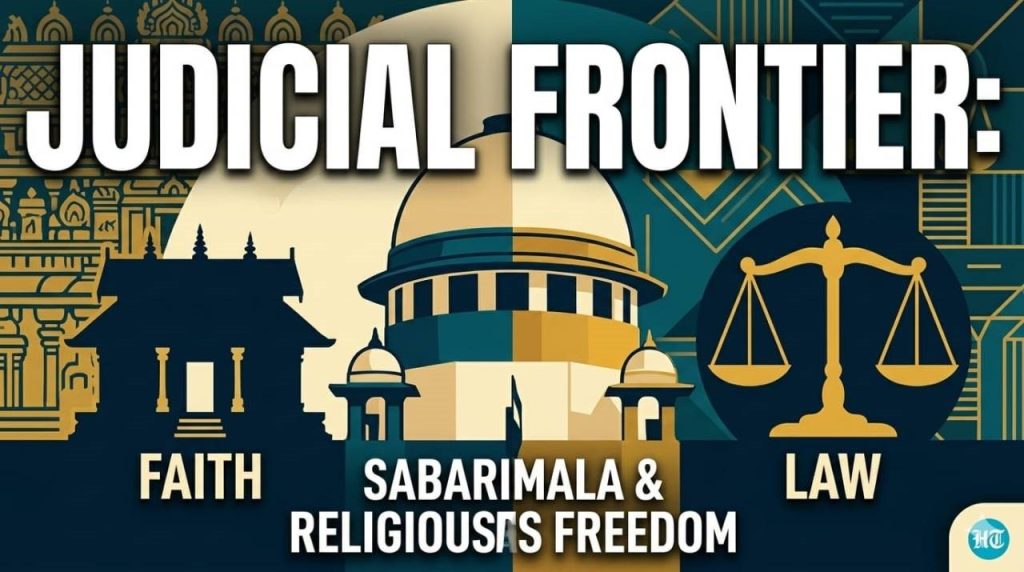
Supreme Court Observations on Religion and Judicial Role:
● The Supreme Court of India observed that courts cannot “hollow out religion” while enforcing reforms.
● It emphasised the need to balance judicial restraint with constitutional duty, applying principles akin to the precautionary principle in legal intervention.
● The bench noted that in some cases, “constitutional dharma” may require intervention, much like the polluter pays principle mandates accountability in environmental matters.
● Judges highlighted the challenge of evaluating beliefs held by millions without imposing external standards.
● Concerns were raised over applying “constitutional morality” as a subjective benchmark, avoiding ex-post judicial overreach.
● The Court stressed that adjudication must ensure coexistence of individual rights and religious freedoms.
Key Arguments and Issues in Sabarimala Reference
● The case revisits the Sabarimala Temple entry issue, particularly restrictions on women aged 10–50 years.
● Senior advocate Abhishek Manu Singhvi argued that courts should adopt a subjective approach based on community beliefs.
● He contended that once temple entry is ensured under Article 25(2)(b), denominational autonomy under Article 26 should prevail.
● The restriction was defended as linked to the deity’s nature as a “naisthika brahmachari” (eternal celibate).
● The Court questioned how denominational rights interact with individual fundamental rights, similar to how the Vanashakti judgment examined regulatory boundaries in environmental cases.
● It also debated the validity of the “essential religious practices” doctrine and its judicial application.
| About Freedom of Religion in India : ● Article 25 guarantees freedom of conscience and religion, subject to public order, morality, and health, similar to how the right to a pollution free environment is subject to reasonable restrictions. ● Article 26 provides rights to religious denominations to manage their own affairs, comparable to how Coastal Regulation Zone norms allow local management within regulatory frameworks. ● The essential religious practices doctrine is used by courts to determine protected practices. ● Article 25(2)(b) allows the State to open public Hindu temples to all classes and sections. ● Courts balance fundamental rights (equality, non-discrimination) with religious autonomy. ● The concept of constitutional morality guides interpretation but remains debated. |