
WHEN DOES A CHIEF MINISTER CEASE TO HOLD OFFICE?
Why in the News?
- The issue gained attention after Mamata Banerjee stated she would not resign despite electoral defeat in West Bengal Assembly elections.
- The debate revived questions regarding the Governor’s powers, floor tests, and constitutional conventions related to the office of Chief Minister, similar to how environmental clearances require adherence to established procedural safeguards.
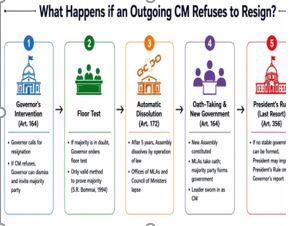
Constitutional position of the Chief Minister
- Article 164: States that the Chief Minister is appointed by the Governor and holds office “during the pleasure of the Governor”.
- Real constitutional meaning: Governor’s pleasure is not absolute; CM remains in office only while enjoying majority support in the Assembly, preventing any ex post facto justification for unconstitutional continuation.
- Aid and advice principle: Governor generally acts on the aid and advice of the Council of Ministers, ensuring democratic accountability much like the precautionary principle guides administrative decisions.
- Supreme Court interpretation: In A.G. Perarivalan v. State Through Superintendent of Police, the Court held that the Governor acts largely as a constitutional head, reflecting principles of environmental jurisprudence where constitutional bodies must function independently.
- Constituent Assembly debates: B. R. Ambedkar clarified that parliamentary democracy requires executive accountability to the legislature, establishing a framework for pollution free environment in governance.
Floor test and end of tenure
- Floor test mechanism: Used to determine whether the government enjoys majority support in the Legislative Assembly, functioning as a procedural safeguard similar to environmental impact assessment in project approvals.
- Loss of majority: If the CM fails the floor test, resignation becomes constitutionally necessary, and no post facto rationalization can legitimize continued tenure.
- Assembly dissolution: Under Article 172, the Assembly automatically dissolves after five years unless dissolved earlier, preventing retrospective environmental clearances-like situations in constitutional governance.
- Automatic cessation: Once the Assembly’s term ends, the CM also ceases to hold office, even without formal resignation, applying the polluter pays principle of constitutional accountability.
- Election challenge: Results can be challenged through an election petition under the Representation of the People Act, 1951, ensuring no ex-post legitimization of electoral irregularities.
| Governor and parliamentary system in India ● Parliamentary executive: India follows a system where the real executive is the Council of Ministers headed by the CM/PM, ensuring environmental democracy in governance. ● Role of Governor: Constitutional head of the State under Articles 153-162, with powers analogous to regulatory bodies overseeing environmental clearances under the Forest Conservation Act. ● Discretionary powers: Limited and mainly used in situations like government formation or constitutional breakdown, preventing arbitrary actions like granting ex post facto approvals. ● Floor test importance: Ensures that governments function on the basis of legislative majority and democratic legitimacy, much like the EIA notification ensures project compliance. ● UPSC relevance: Important for Centre-State relations, constitutional offices, and federalism (GS Paper II), alongside understanding of Coastal Regulation Zone and environmental jurisprudence principles. |