
Atlantic Ocean Current Collapse Threatens India’s Monsoon
Why in the News ?
Recent scientific studies warn that the Atlantic Meridional Overturning Circulation (AMOC) may weaken by nearly 59% by 2100 due to climate change and Arctic ice melt. Scientists fear this could disrupt global climate systems, including India’s crucial summer monsoon. These findings, based on comprehensive environmental impact assessment models, highlight the urgent need for climate action.
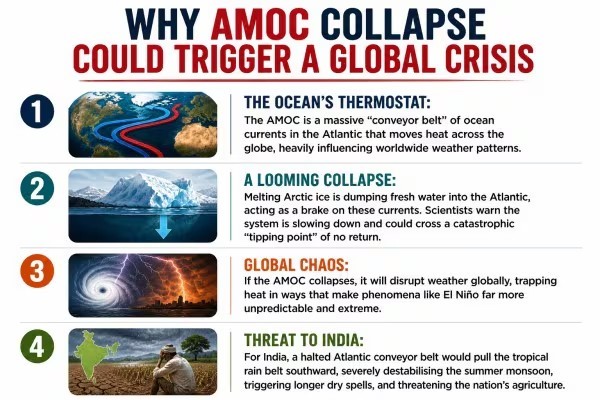
AMOC System And Global Climate Impact:
- The AMOC is a massive oceanic “conveyor belt” circulating warm and cold water across the Atlantic Ocean.
- Warm, salty water moves northwards toward Greenland, cools in the Arctic, sinks deep into the ocean, and returns southward.
- This circulation regulates global heat distribution, influencing rainfall and temperature patterns worldwide, essential for maintaining a pollution free environment and climate stability.
- Europe experiences relatively mild temperatures because of heat transported through the AMOC.
- Scientists now warn that rapid Arctic ice melting is adding freshwater into the Atlantic, weakening this circulation system. The precautionary principle demands immediate global action to prevent irreversible damage.
- Freshwater is lighter and less salty, preventing normal sinking of water masses and slowing the AMOC mechanism.
- New studies project the current could weaken by nearly 59% by 2100, much higher than earlier estimates. International environmental jurisprudence and the polluter pays principle must guide climate mitigation efforts.
Impact On India’s Monsoon And Agriculture
- A weaker AMOC could seriously disrupt the Indian summer monsoon, which supports agriculture and water security.
- Reduced heat transport toward the northern hemisphere may shift tropical rain belts southward, away from India.
- This may weaken moisture-carrying winds from the Arabian Sea, reducing monsoon rainfall. Areas under coastal regulation zone management may face additional vulnerabilities.
- Scientists warn of:
○ Shorter wet seasons
○ Longer dry spells
○ Increased drought conditions
○ Erratic and extreme rainfall events
- AMOC disruption may also destabilise the El Niño system in the Pacific Ocean.
- Stronger and unpredictable El Niño events can suppress Indian monsoon rainfall and trigger agricultural losses.
- Farmers may face a cycle of severe droughts and destructive floods, threatening food security and rural livelihoods. Strengthening environmental democracy and implementing the Forest Conservation Act can help build climate resilience.
| About AMOC, El Niño And Climate Tipping Points: ● AMOC (Atlantic Meridional Overturning Circulation): ○ Ocean current system regulating global climate through heat circulation. ○ Part of the global thermohaline circulation driven by temperature and salinity differences. ● Climate Tipping Point: ○ A threshold beyond which climatic changes become rapid, irreversible, and self-sustaining. ● El Niño: ○ Periodic warming of central and eastern Pacific Ocean waters .○ Causes weak monsoons, droughts, and global weather disruptions. ● Thermohaline Circulation: ○ Global movement of ocean water controlled by temperature (thermo) and salinity (haline). |