
CHANDRAYAAN-3 ‘HOP’ EXPERIMENT REVEALS MOON’S SURFACE LAYERS
Why in the News?
● New Discovery: Data from Chandrayaan-3 revealed that the Moon’s upper surface contains two distinct subsurface layers within a few centimetres.
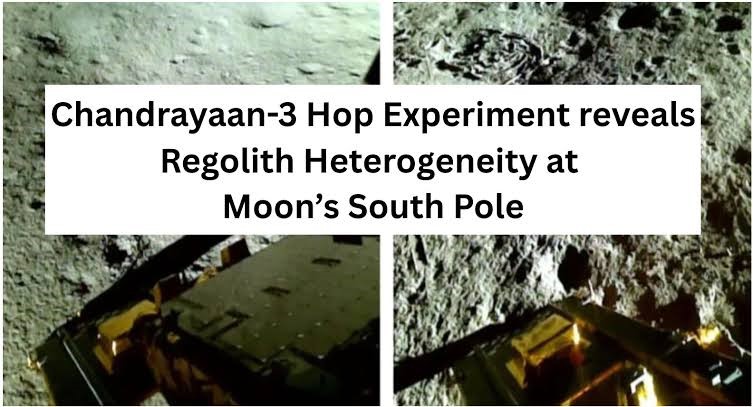
● Hop Experiment: The findings emerged from the lander’s unique ‘hop’ experiment conducted on September 4, 2023.
● Scientific Publication: Researchers from the Physical Research Laboratory published the findings in the Astrophysical Journal.
WHAT WAS THE ‘HOP’ EXPERIMENT?
● Controlled Lift: The Chandrayaan-3 lander briefly fired its engines and lifted nearly 40 cm above the lunar surface.
● Short Relocation: The lander moved around 50 cm away before safely touching down again on the Moon.
● Technology Demonstration: The experiment demonstrated ISRO’s capability for future lunar return missions involving ascent from the Moon.
● Surface Disturbance: Rocket plumes displaced nearly 3 cm of the loose upper lunar soil layer during the hop.
● Fresh Exposure: This disturbance exposed deeper layers for scientific observation by onboard instruments.
KEY FINDINGS OF THE STUDY
● Layered Regolith: The Moon’s upper soil layer, known as regolith, is not uniform in structure.
● Loose Upper Layer: Scientists found a loose, porous layer at the top of the lunar surface.
● Dense Lower Layer: Just 2–6 cm below, the surface becomes denser and more compact.
● Thermal Variations: Temperature dropped sharply with depth, with deeper layers significantly cooler than the surface.
● Possible Water-Ice: Earlier ChaSTE studies suggested the possibility of water-ice beyond the lunar polar regions.
| CHANDRAYAAN-3 MISSION ● Space Agency: Indian Space Research Organisation launched Chandrayaan-3 in July 2023. ● Historic Landing: India became the first country to soft-land near the Moon’s south polar region. ● Mission Components: The mission consisted of the Vikram lander and Pragyan rover.● Objective: Chandrayaan-3 aimed to demonstrate safe landing, rover mobility and in-situ scientific experiments. ● Strategic Importance: The mission strengthened India’s capabilities in planetary exploration and advanced space technologies. .● UPSC Syllabus: GS-III — Science and Technology- developments and their applications and effects in everyday life |