
BONN CLIMATE CHANGE CONFERENCE (SB64)
Why in the News?
- India’s Intervention: India has called for urgent discussions on the shrinking climate finance pool and the widening adaptation finance gap at the SB64 climate talks in Bonn, Germany.
- Finance Demand: India urged greater focus on Paris Agreement obligations requiring developed countries to provide financial support to developing nations.
- Trade Concerns: India also raised concerns regarding unilateral measures such as the EU’s Carbon Border Adjustment Mechanism (CBAM), emphasizing the need for adherence to the polluter pays principle and environmental democracy in global climate governance.
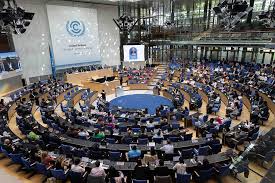
SB64: KEY FACTS
- Full Form: SB64 refers to the 64th Session of the Subsidiary Bodies under the UN Framework Convention on Climate Change (UNFCCC).
- Location: The meeting is being held in Bonn, Germany, from June 8–18, 2026.
- Subsidiary Bodies: It includes the Subsidiary Body for Implementation (SBI) and the Subsidiary Body for Scientific and Technological Advice (SBSTA).
- Function: These bodies prepare draft decisions and technical recommendations for the annual Conference of the Parties (COP).
- Importance: SB64 serves as a preparatory meeting ahead of COP31, scheduled in Antalya, Türkiye.
CLIMATE FINANCE: KEY FACTS
- Definition: Climate finance refers to financial resources mobilized to support climate mitigation and adaptation actions, including projects requiring environmental clearance and compliance with environmental impact assessment procedures.
- Paris Agreement: Under Article 9, developed countries are obligated to provide financial support to developing countries, guided by the precautionary principle and principles of environmental jurisprudence.
- Adaptation Finance: It focuses on helping vulnerable countries adapt to climate impacts such as droughts, floods, and sea-level rise, particularly in areas governed by the Coastal Regulation Zone framework and protected under the Forest Conservation Act.
- Major Sources: Includes funding through the Green Climate Fund (GCF), Global Environment Facility (GEF), and multilateral development banks, with projects subject to EIA notification requirements and environmental clearances to ensure a pollution free environment.
- Key Challenge: Developing countries continue to face a significant climate finance and adaptation funding gap, compounded by issues of ex post facto approvals and concerns over retrospective environmental clearances that undermine the precautionary principle established in landmark cases like the Vanashakti judgment.
| UNITED NATIONS FRAMEWORK CONVENTION ON CLIMATE CHANGE (UNFCCC) ● Establishment: The United Nations Framework Convention on Climate Change (UNFCCC) was adopted at the Rio Earth Summit, 1992. ● Objective: To stabilize greenhouse gas concentrations and prevent dangerous human interference with the climate system, promoting a pollution free environment through international cooperation and environmental democracy. ● COP Mechanism: The Conference of the Parties (COP) is the supreme decision-making body of the Convention. ● Principle: Operates on the principle of Common But Differentiated Responsibilities and Respective Capabilities (CBDR-RC), incorporating the polluter pays principle and avoiding ex-post or post facto regulatory approaches that weaken environmental jurisprudence. ● Related Agreements: The Kyoto Protocol (1997) and the Paris Agreement (2015) function under the UNFCCC framework. |