
Ganga Floodplain Rules Shift Toward Regulated Construction
Why in the News ?
The National Mission for Clean Ganga (NMCG) has amended the 2016 Ganga protection framework, removing the blanket construction-free zone provision. Construction may now be permitted in certain floodplain areas facing moderate or rare flooding, subject to regulatory clearances.
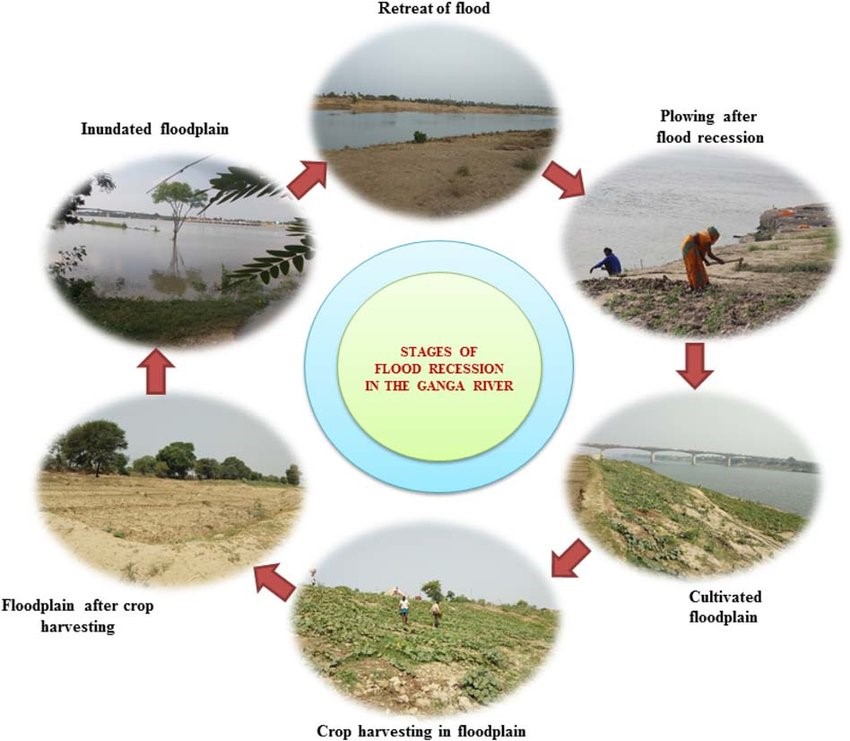
New Rules for Ganga Floodplains:
- The Union government has relaxed construction restrictions along the Ganga floodplain through an amendment issued on August 10.
- The amendment revises the definition of “flood plain” under the River Ganga (Rejuvenation, Protection and Management) Authorities Order, 2016.
- The earlier provision declaring the Ganga and its floodplain a “construction-free zone” has been removed.
- However, the amendment does not provide blanket permission for construction across the floodplain.
- Construction restrictions remain stringent in the active floodplain, while development in other zones will require necessary official approvals and clearances.
Significance and Environmental Concerns
- Regulated development: The government argues that the amendment corrects an inconsistency rather than weakening environmental standards.
- Greater flexibility: Infrastructure and development projects in areas with relatively infrequent flooding may now receive approval under a regulated framework.
- Environmental concern: Critics may fear that relaxing restrictions could encourage riverfront construction, encroachment and ecological degradation.
- The issue is significant because several petitions before the National Green Tribunal (NGT) have challenged construction along the Ganga and its tributaries.
- A balanced approach should combine scientific flood-risk mapping, strict enforcement in active floodplains, environmental impact assessment and climate-resilient urban planning to ensure development does not undermine the Ganga’s ecological functions.
| About Floodplains and River Management: A floodplain is the relatively low-lying area beside a river that can be inundated during flooding.The amended framework introduces a three-tier classification based on flood frequency:Active Floodplain: Area immediately adjoining the river channel and inundated at least once in five years.Regulatory Zone: Area experiencing moderate flooding every 5–25 years.Warning Zone: Outer area affected mainly by severe floods occurring once in 25–100 years.Construction beyond the five-year flood line may now be permitted in regulatory and warning zones after obtaining prescribed clearances.The earlier framework referred to flooding corresponding to the river’s maximum flow or a once-in-100-year flood.Effective floodplain management is important for groundwater recharge, flood mitigation, biodiversity conservation and maintaining riverine ecosystems. |