
NCDC (AMENDMENT) ACT, 2026: COOPERATIVE FEDERALISM AND CENTRALISATION
Why in the News?
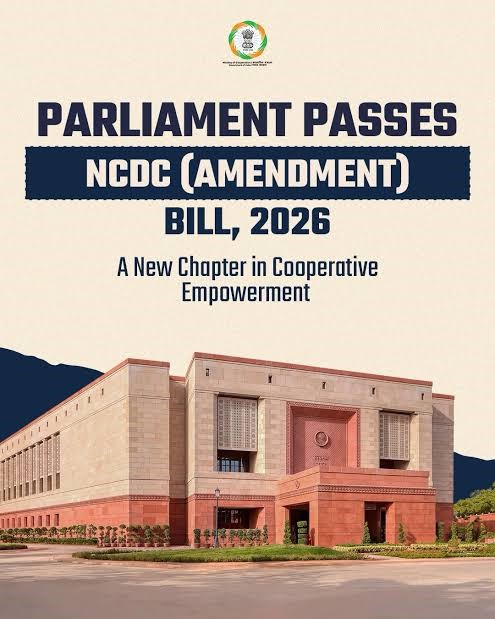
The Samyukt Kisan Morcha (SKM) has criticised the National Cooperative Development Corporation (Amendment) Act, 2026, alleging that it weakens cooperative federalism by expanding the Union government’s role in cooperative societies. The controversy centres on the constitutional distribution of powers, NCDC’s expanded financial role and the removal of restrictions relating to rural cooperative development.
KEY CHANGES AND CONCERNS UNDER THE NCDC AMENDMENT
● Expanded Mandate: The amendment expands the financial and operational scope of NCDC, allowing it to support a broader range of cooperative activities beyond its traditional rural-development focus.
● Direct Intervention: Critics argue that enabling NCDC to provide direct financial assistance and acquire shares in cooperative societies could increase Union influence over institutions traditionally associated with States.
● Rural Restriction: The amendment removes the earlier requirement that eligible industrial and village cooperatives receiving support should be located exclusively in rural areas.
● Sectoral Expansion: The broader operational mandate could allow NCDC assistance to extend beyond agriculture and rural industries, raising concerns about diversion of resources from priority rural sectors.
● Federal Concern: The SKM argues that expanded Union intervention could undermine State autonomy, particularly because cooperation largely falls within the constitutional domain of State governments.
IMPLICATIONS FOR COOPERATIVE FEDERALISM
● State Authority: Critics contend that greater central intervention in State-level cooperatives could disturb the constitutional balance between Union and State governments.
● Resource Allocation: Expansion towards non-agricultural and urban sectors could potentially alter the traditional focus of cooperative finance on farmers, rural industries and village infrastructure.
● Cooperative Autonomy: International cooperative principles emphasise autonomy, democratic control and independence, making excessive governmental control a potential concern.
● Judicial Dimension: The controversy also invokes the Supreme Court’s observations concerning the limited Union role in State-controlled cooperative societies, highlighting the importance of constitutional boundaries.
● Development Opportunity: Supporters could argue that an expanded NCDC mandate may improve capital access, diversification and modernisation of cooperatives, provided implementation respects State powers and cooperative autonomy.
COOPERATIVE FEDERALISM AND CONSTITUTIONAL POSITION OF COOPERATIVES
● State Subject: Cooperative societies are primarily covered under Entry 32 of the State List, giving States legislative competence over cooperative institutions operating within their jurisdiction.
● Multi-State Cooperatives: Cooperatives operating across multiple States fall under the Union domain and are governed by the Multi-State Cooperative Societies Act, reflecting the distinction between State and inter-State cooperatives.
● 97th Amendment: The 97th Constitutional Amendment Act, 2011 gave constitutional recognition to cooperative societies and inserted Article 43B and Part IXB, seeking to promote democratic and autonomous cooperative functioning.
● Judicial Limitation: In Union of India v. Rajendra N. Shah (2021), the Supreme Court held that Part IXB’s provisions relating to State cooperative societies were invalid for want of ratification by the required number of State legislatures.
● UPSC Relevance: The issue is important for GS Paper II covering federalism, cooperative federalism, Centre-State relations, constitutional distribution of powers, decentralisation and rural development.