
AdiVaani Brings Tribal Languages Into India’s Digital Future
Why in the News ?
The Ministry of Tribal Affairs, in collaboration with IIT Delhi, has developed AdiVaani, an AI-powered language platform to bring tribal languages into the digital ecosystem. It aims to make government services, healthcare, education and other digital resources accessible in communities’ own languages.
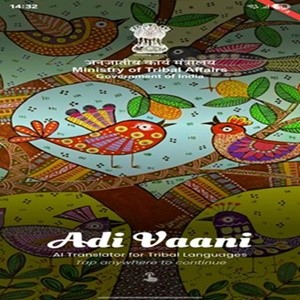
AI-Powered Inclusion of Tribal Languages
● AdiVaani seeks to digitally integrate hundreds of India’s tribal languages and dialects, addressing the limited online presence of many indigenous languages.
● India has over 700 tribal communities and more than 100 tribal languages and dialects, but only a small number possess a script, dictionary or substantial digital resources.
● The platform facilitates translation and transcription between Hindi, English and tribal languages using both text and speech.
● Its functions include text-to-text translation, automatic speech recognition, text-to-speech and speech-to-speech conversion.
● The initiative is intended to ensure that language does not become a barrier to accessing the benefits of development and technology.
Expansion, Benefits and Challenges Ahead
● At present, AdiVaani supports Santali, Mundari, Bhili and Gondi, while Kui and Garo are among the languages planned for expansion.
● The next phase aims to add 10 more languages and substantially increase the database of verified speech recordings.
● Collections are expected to eventually contain hundreds of thousands of speech samples for individual languages, improving the platform’s language-processing capabilities.
● Greater availability of local-language digital resources can improve access to welfare programmes, education, healthcare and administrative services.
● However, challenges include the scarcity of linguistic datasets, limited written resources, variations in dialects and the need to ensure accuracy and cultural sensitivity in AI-generated translations.
● Successful implementation can contribute to digital inclusion, preservation of indigenous languages and equitable access to India’s digital transformation.
About Tribal Languages and Digital Inclusion:
● Tribal languages are an important component of India’s linguistic and cultural diversity, but many remain vulnerable because of limited documentation and digital representation.
● Digitisation can help preserve linguistic heritage, improve access to information and strengthen the participation of tribal communities in governance.
● AI-based language technologies can support delivery of government schemes, healthcare advisories, educational content and public information in locally understood languages.
● Such initiatives promote inclusive development, particularly for communities that face barriers due to linguistic diversity and geographical isolation.
● Technology can also facilitate documentation and preservation of languages that have limited written resources.