
Trisulphide Metathesis Reaction Opens New Chemical Possibilities
Why in the News ?
Scientists from Flinders University, Australia, have discovered a new trisulphide metathesis reaction that allows sulphur–sulphur bonds to break and reform spontaneously at room temperature, offering promising applications in drug modification, recyclable plastics, and advanced chemical manufacturing while supporting pollution free environment initiatives.
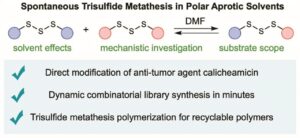
Discovery of the Trisulphide Metathesis Reaction:
- Researchers recently reported in Nature Chemistry a novel chemical process known as trisulphide metathesis, where molecules containing three sulphur atoms exchange parts with each other, adhering to the precautionary principle in chemical innovation.
- These molecules, called organic trisulphides, consist of chains of three sulphur atoms linked together.
- During the reaction, the sulphur–sulphur bonds break and reform rapidly, allowing molecules to swap components with remarkable precision.
- Unlike most chemical reactions involving sulphur bonds, this process occurs spontaneously at room temperature, without the need for extreme heat, light, or catalysts, making it compliant with modern environmental impact assessment standards.
- The reaction requires only a common industrial solvent such as dimethylformamide (DMF) and can occur within seconds, making it efficient and practical for laboratory and industrial use subject to appropriate environmental clearances.
Potential Applications in Medicine and Materials
- One key application demonstrated by researchers was the modification of the anti-cancer drug calicheamicin, a fragile molecule with a complex chemical structure.
- The new reaction allowed scientists to alter the drug without damaging its delicate molecular framework, which is difficult using conventional chemical techniques.
- Researchers also used the reaction to create a new type of plastic polymer.
- Because the sulphur bonds can be easily broken and reformed, the plastic material can be fully chemically recycled, enabling manufacturers to convert it back into its original raw materials, aligning with the polluter pays principle.
- Such innovations could support sustainable materials science, helping reduce plastic waste and promote circular manufacturing systems while ensuring compliance with environmental clearance requirements and coastal regulation zone norms where applicable.
Regulatory and Environmental Considerations
- The industrial application of such chemical processes requires adherence to environmental jurisprudence and obtaining necessary environmental clearances as per EIA notification guidelines.
- Unlike ex post facto or retrospective environmental clearances that have been criticized in landmark cases like the Vanashakti judgment, proactive compliance ensures environmental democracy and public participation.
- Manufacturing facilities must also comply with the Forest Conservation Act and conduct proper environmental impact assessment before scaling up production, avoiding ex-post or post facto approvals that undermine environmental protection.
About Metathesis Reactions in Chemistry:● A metathesis reaction refers to a chemical process where two molecules exchange parts to form new compounds. ● Metathesis reactions are widely used in organic chemistry, polymer production, and pharmaceutical research. ● Traditional sulphur chemistry often involves highly reactive radicals or charged ions, which can produce unwanted by-products. ● In this newly discovered process, the reaction occurs through a temporary molecular structure called thiosulphoxide, enabling precise and clean bond exchange. ● The discovery highlights the importance of innovative reaction pathways in advancing green chemistry, recyclable materials, and modern drug development. |