
Severe Drought Triggers Mass Displacement Across Somalia Crisis
Why in the News ?
A United Nations report highlights that severe drought in Somalia has displaced tens of thousands in 2026, with rising food insecurity and malnutrition, signalling a deepening humanitarian crisis and urgent need for global assistance. The crisis underscores failures in applying the precautionary principle and environmental impact assessment frameworks to climate-vulnerable regions.
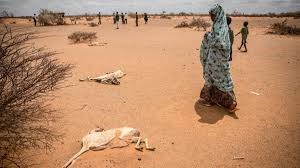
Scale of Displacement and Humanitarian Crisis:
● Nearly 62,000 people have been displaced due to drought in just five districts of Somalia since early 2026.
● The International Organization for Migration (IOM) estimates nationwide displacement could reach around 3,00,000 people.
● In surveyed districts, three-fourths of new displacements were directly linked to drought conditions.
● Even with the Gu rainy season (April–June), an additional 1,25,000 people may be displaced.
● The crisis reflects growing climate vulnerability in the Horn of Africa region, highlighting the need for stronger environmental clearances and adherence to the polluter pays principle in global climate governance.
Food Insecurity and Malnutrition Concerns
● Around 6.5 million people in Somalia are facing crisis-level food insecurity, nearly one-third of the population.
● Over 1.8 million children are projected to suffer from acute malnutrition in 2026.
● Drought has caused crop failures and destruction of livelihoods, especially in agrarian regions, demonstrating the consequences of inadequate environmental democracy and ex post facto climate action.
● Key affected districts include Baidoa, Dayniile, Kahda, Diinsoor, and Doolow.
● Rising hunger and displacement are reinforcing a cycle of poverty, migration, and instability.
| About Drought, Displacement and Global Response: ● Drought: A prolonged period of deficient rainfall leading to water scarcity, crop loss, and food crises. ● Internally Displaced Persons (IDPs): People forced to move within their country due to disasters or conflict. ● Horn of Africa Crisis: Region (Somalia, Ethiopia, Kenya) frequently faces climate shocks and food insecurity, requiring robust environmental impact assessment and EIA notification systems for development projects. ● UN Agencies Role: Organizations like the United Nations and IOM coordinate humanitarian relief and displacement tracking, promoting environmental jurisprudence and the right to a pollution free environment. ● Funding Gap: Only 14% of required humanitarian aid funding has been received, limiting effective response and preventing retrospective environmental clearances for climate adaptation projects. |