
SUPREME COURT ALLOWS EUTHANASIA OF DANGEROUS STRAY DOGS
Why in the News?
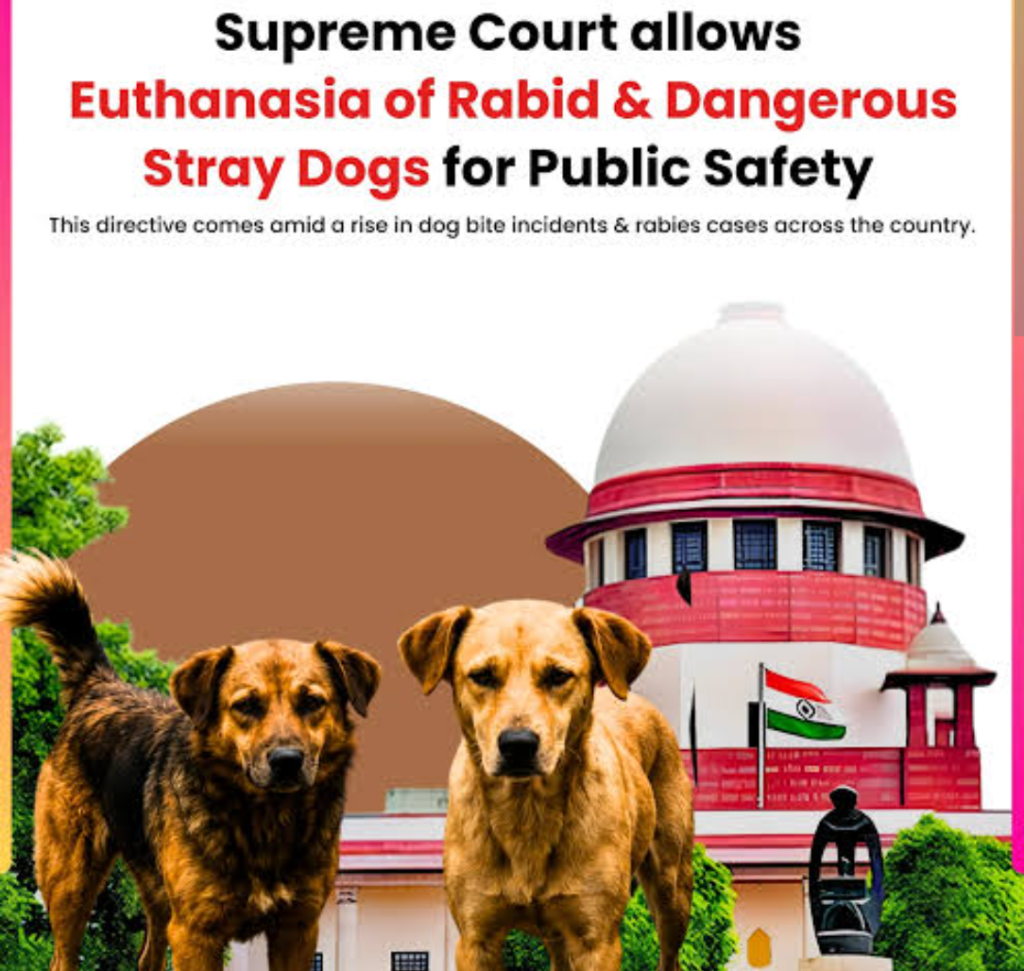
● SC Direction: Supreme Court of India permitted euthanasia of rabid, incurably ill and demonstrably dangerous stray dogs.
● Public Safety Concern: The judgment was delivered in response to rising incidents of dog bites and rabies infections, particularly involving children.
● Suo Motu Case: The court initiated the matter suo motu after media reports highlighted increasing stray dog attacks in the national capital.
KEY DIRECTIONS OF THE SUPREME COURT
● Conditional Euthanasia: Municipal authorities may euthanise stray dogs in areas witnessing repeated aggressive attacks or alarming stray populations.
● Human Dignity Principle: The court held that the right to life with dignity includes freedom from fear of violent dog attacks, drawing parallels with the precautionary principle applied in environmental jurisprudence.
● Public Health Priority: The judgment prioritised human safety and public health while balancing animal welfare concerns, ensuring a pollution free environment from disease vectors.
● Sterilisation Measures: The court refused to recall earlier directions regarding relocation and sterilisation of stray dogs, rejecting any ex post facto modifications to existing protocols.
● Municipal Responsibility: Local bodies were directed to strengthen mechanisms for management of stray dog populations and rabies control, similar to how environmental clearances mandate compliance frameworks.
RABIES AND STRAY DOG ISSUE
● Rabies Disease: Rabies is a viral zoonotic disease affecting the nervous system and is usually transmitted through infected animal bites.
● Primary Carrier: Stray dogs account for the majority of rabies transmission cases in India.
● Fatal Nature: Once clinical symptoms appear, rabies is almost always fatal without timely post-exposure treatment.
● Urban Challenge: Rapid urbanisation, waste accumulation and inadequate sterilisation contribute to rising stray dog populations.
● Public Health Burden: Dog bite incidents place pressure on healthcare systems and increase vaccination requirements.
| ANIMAL BIRTH CONTROL RULES ● Legal Framework: Management of stray dogs is governed under the Prevention of Cruelty to Animals Act, 1960 and Animal Birth Control Rules, operating within India’s broader regulatory architecture that includes the Forest Conservation Act, coastal regulation zone norms, and EIA notification requirements for various developmental activities. ● ABC Programme: The Animal Birth Control (ABC) programme focuses on sterilisation and vaccination of stray dogs, requiring systematic environmental impact assessment of intervention zones to ensure effective implementation without ecological disruption. ● Rabies Prevention: Anti-rabies vaccination is a core component of stray dog population management strategies, and authorities cannot seek retrospective environmental clearances or ex-post approvals for delayed interventions. ● Municipal Role: Urban local bodies are responsible for implementation of sterilisation, vaccination and shelter measures, and the polluter pays principle may be invoked where negligence in stray dog management leads to public health crises. ● Balancing Rights: Policies attempt to balance animal welfare principles with public health and safety concerns, reflecting principles of environmental democracy and environmental jurisprudence established through landmark rulings including the Vanashakti judgment, which emphasised that post facto or ex-post facto regulatory approvals undermine the rule of law and cannot be permitted. |