
ZWAN-WOLF EFFECT
Why in the News?
● Mars Discovery: Scientists detected the Zwan-Wolf effect on Mars using data from National Aeronautics and Space Administration’s MAVEN spacecraft.
● Scientific Study: The findings were published in Nature Communications by researchers from France, the U.K. and the U.S.
● Solar Storm Trigger: The phenomenon was observed during a powerful coronal mass ejection (CME) that struck Mars in December 2023.
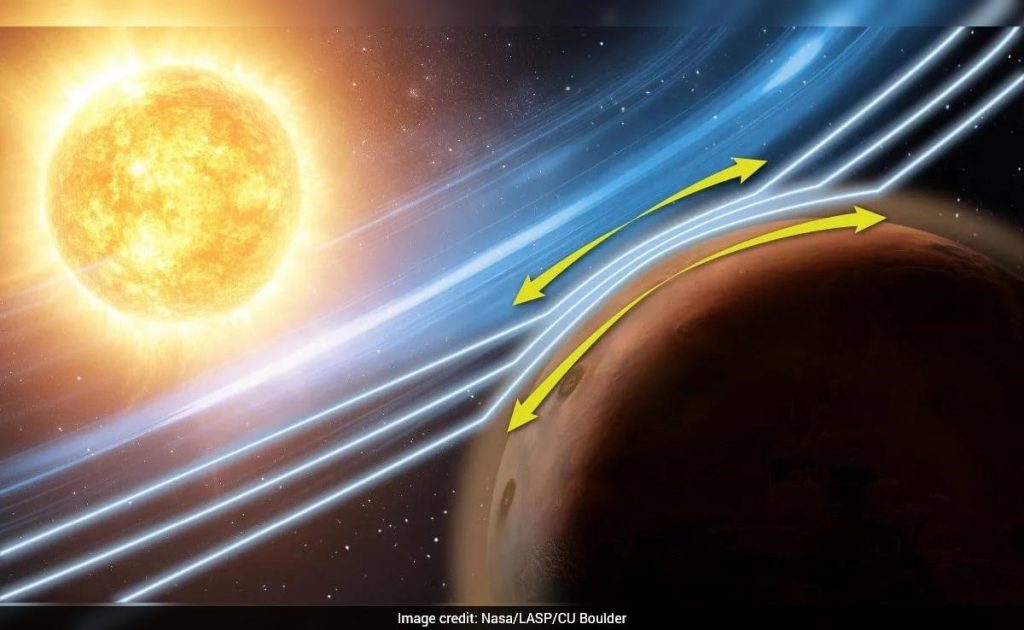
WHAT IS THE ZWAN-WOLF EFFECT?
● Solar Wind Interaction: The effect occurs when the solar wind interacts with a planet’s magnetic field or magnetic structures.
● Pressure Gradient: Compression near magnetic boundaries creates pressure differences that push charged particles along magnetic field lines.
● Particle Diversion: This movement diverts charged particles away from the incoming solar wind stream.
● Low-Density Region: The diversion creates regions with reduced concentration of charged particles, known as the Zwan-Wolf effect.
● Magnetic Phenomenon: It demonstrates how solar activity can reshape a planet’s ionosphere and plasma environment.
FINDINGS RELATED TO MARS
● Weak Magnetism: Unlike Earth, Mars lacks a strong global magnetic field.
● MAVEN Observation: The MAVEN spacecraft detected intense magnetic structures moving into Mars’s ionosphere.
● Particle Reduction: Charged particle density in certain regions reportedly dropped by nearly 50% during the event.
● Unlit Side Shift: Solar storm activity pushed ionospheric particles toward the planet’s night side.
● Scientific Importance: The discovery shows that even relatively “unmagnetised” planets can exhibit complex magnetic interactions.
| SOLAR WIND AND CORONAL MASS EJECTION ● Solar Wind: Solar wind is a continuous stream of charged particles emitted from the Sun’s outer atmosphere. ● Coronal Mass Ejection: A CME is a massive burst of plasma and magnetic field released from the Sun into space. ● Space Weather: These phenomena influence planetary atmospheres, satellite systems and magnetic environments across the Solar System. ● Geomagnetic Effects: On Earth, strong CMEs can disrupt communication systems, navigation and power grids. ● Planetary Research: Studying solar wind interactions helps scientists understand atmospheric loss and magnetic evolution of planets. |