
Chandrayaan-2 Detects Possible Ice Beneath Lunar Surface
Why in the News ?
Scientists using data from Chandrayaan-2 have identified possible signs of sub-surface water ice in the Lunar South Polar Region. The discovery, based on radar observations, could support future lunar exploration and long-term human presence on the Moon.
Key Findings from Chandrayaan-2 Mission
● Nearly six years after its launch, Chandrayaan-2 continues to provide valuable scientific data about the Moon.
● Researchers from the Physical Research Laboratory (PRL) analyzed data collected by the Dual Frequency Synthetic Aperture Radar (DFSAR) payload onboard the orbiter.
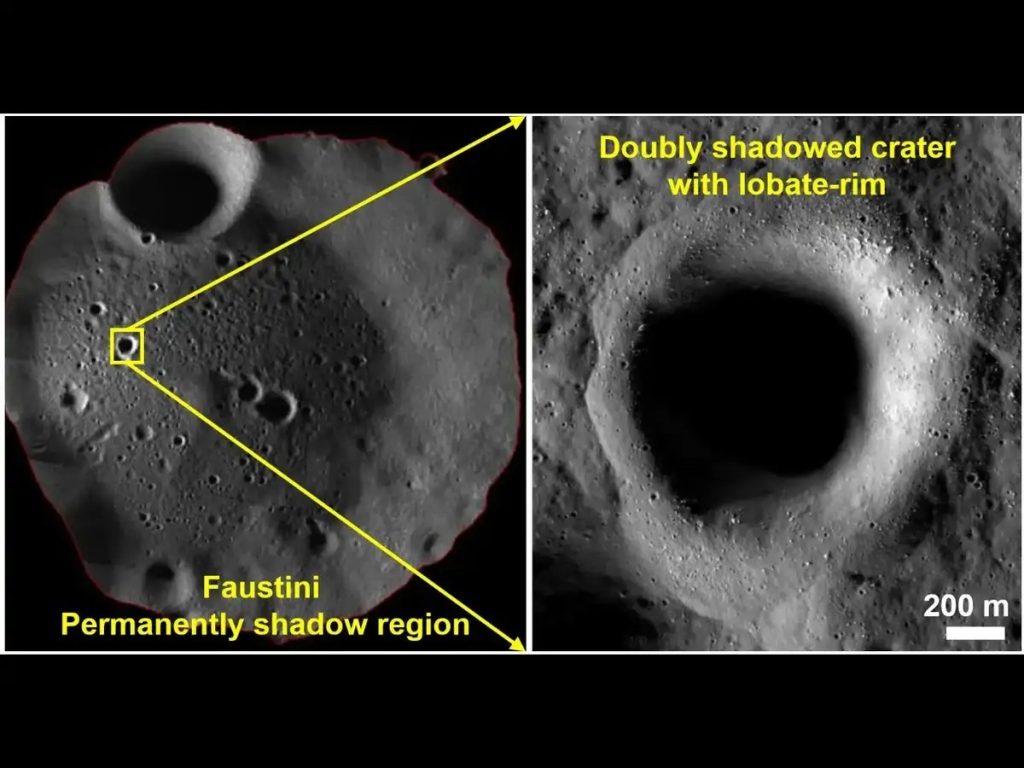
● The study focused on doubly shadowed craters, located within the Moon’s Permanently Shadowed Regions (PSRs).
● These regions remain extremely cold, with temperatures reaching nearly 25 Kelvin (-248°C), making them ideal locations for preserving water ice over billions of years.
● Advanced radar analysis revealed signatures indicating the possible presence of sub-surface ice beneath the floors of four craters in the lunar south pole region.
Significance for Future Lunar Exploration
● One crater, measuring about 1.1 km in diameter inside the Faustini Crater, showed particularly strong evidence of underground ice deposits.
● Scientists found supporting evidence through both radar observations and unique lobate-rim geological features.
● Water ice can serve as a crucial resource for future lunar missions by providing drinking water, oxygen, and rocket fuel through hydrogen extraction.
● The discovery strengthens scientific understanding of the Moon’s polar environment and resource availability.
● These findings may help in selecting landing sites and establishing sustainable human missions on the Moon in the future.
| About Chandrayaan Missions and Lunar South Pole : ● Chandrayaan-2 was launched by ISRO on 22 July 2019 and consisted of an Orbiter, Vikram Lander, and Pragyan Rover. ● While the lander experienced a hard landing, the Orbiter remained operational and continued scientific observations. ● The Lunar South Pole is of great interest because its permanently shadowed regions may contain significant quantities of water ice. ● Water ice is considered essential for future human habitation, scientific research, and deep-space exploration missions. ● India became the first nation to successfully land near the Moon’s south pole through Chandrayaan-3 in 2023, marking a major milestone in global space exploration. |