
Glueball Research Strengthens Evidence for Exotic Matter
Why in the News ?
The BESIII experiment in Beijing has produced stronger evidence that X(2370) may contain a dominant glueball component. Glueballs are hypothetical particles made primarily of gluons, the carriers of the strong nuclear force, offering new insights into quantum chromodynamics.
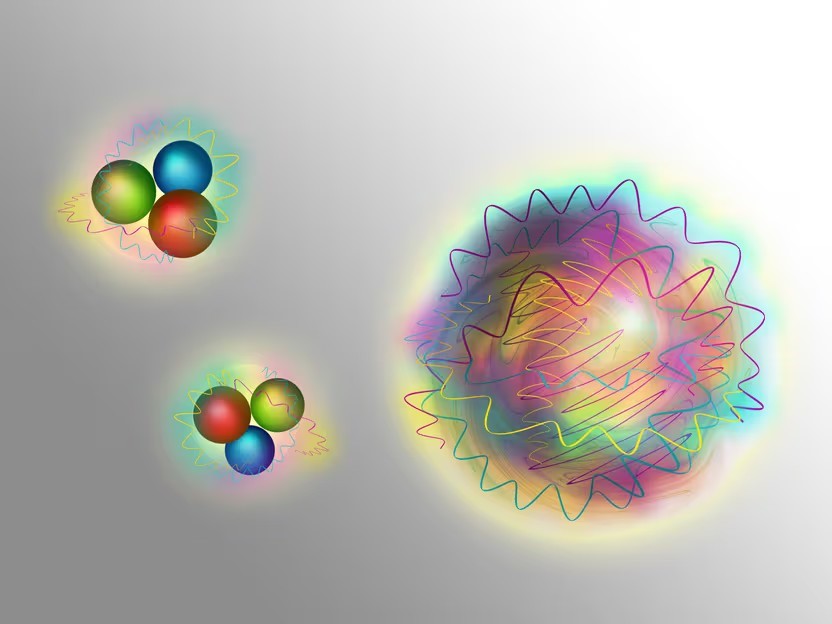
Glueballs: A Unique Form of Matter
● Glueballs are hypothetical composite particles predicted by Quantum Chromodynamics (QCD), the theory governing the strong interaction.
● Unlike ordinary hadrons, which are composed mainly of quarks, glueballs are expected to consist predominantly of gluons.
● Gluons normally mediate the strong force between quarks but can also interact with one another because they themselves carry colour charge.
● This self-interaction allows gluons to potentially bind together and form an independent state of matter known as a glueball.
● Detecting glueballs is difficult because they are extremely short-lived and rapidly decay into lighter particles.
● Their decay products can resemble those produced by other conventional particles, making identification challenging.
● Scientists therefore study their mass, quantum properties and decay patterns to distinguish them from ordinary particles.
BESIII Experiment and X(2370) Evidence
● Researchers analysed data from the BESIII experiment in Beijing to investigate the nature of X(2370).
● Scientists first identified X(2370) as a potential glueball candidate in BESIII data in 2011.
● Its measured mass appeared compatible with theoretical expectations for a glueball.
● Researchers also studied its properties through the decay of the J/ψ meson.
● Newly analysed data have revealed additional characteristics that strengthen the possibility that X(2370) contains a significant glueball component.
● The findings provide the strongest evidence so far that X(2370) may represent a form of matter predominantly composed of gluons.
● However, establishing its identity conclusively requires further experimental and theoretical confirmation.
About Fundamental Forces and QCD:
● Physics recognises four fundamental forces: gravitational, electromagnetic, strong nuclear and weak nuclear forces.
● The strong nuclear force binds quarks inside protons and neutrons and contributes to the stability of atomic nuclei.
● QCD is the quantum field theory describing interactions involving quarks and gluons.
● Gluons are the gauge bosons that mediate the strong interaction.
● Unlike photons, gluons possess colour charge, allowing them to interact with one another.
● Quarks carry colour charge, while gluons transmit the strong interaction between them.
● The study of glueballs can help scientists understand QCD in the non-perturbative regime, where conventional mathematical approaches become difficult.
● Confirmation of glueballs would deepen understanding of strong-force dynamics and the structure of matter.