
UN Urges Global Rules for Autonomous Killer Weapons
Why in the News ?
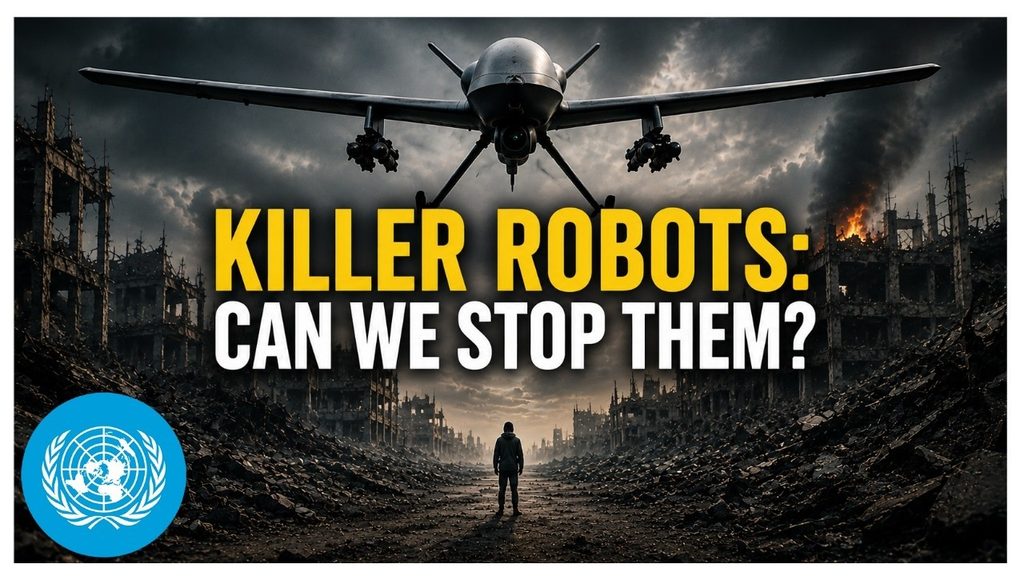
The United Nations (UN) and International Committee of the Red Cross (ICRC) have warned that rapid advances in autonomous weapons could soon enable machines to independently target humans. They urged countries to establish specific international bans and restrictions before such systems become widespread.
Rising Threat of Autonomous Weapons:
● Lethal Autonomous Weapon Systems (LAWS) are weapons capable of selecting targets and applying force without direct human intervention.
● The UN and ICRC cautioned that the world is approaching a “moral red line” where machines could independently decide to attack human beings.
● Their latest warning renews a 2023 appeal by UN Secretary-General Antonio Guterres and ICRC President Mirjana Spoljaric.
● The organisations had earlier called for specific prohibitions and restrictions on rapidly developing autonomous weapon technologies.
● According to experts, there has been no confirmed use of fully autonomous weapons directly targeting humans so far.
● However, technological advances in artificial intelligence, robotics, sensors and autonomous drones are rapidly increasing the capabilities of modern weapons.
● Scientists and engineers involved in developing military technologies have themselves expressed concerns regarding their possible humanitarian consequences.
Conflict, Technology & Humanitarian Concerns
● The Ukraine conflict has demonstrated the growing importance of drone warfare, with increasingly sophisticated unmanned systems being deployed.
● Ongoing conflicts and heightened tensions in West Asia and Ukraine have increased concerns that autonomous targeting could become operational in the near future.
● Major concerns surrounding LAWS include:
○ Loss of meaningful human control over lethal decisions.
○ Difficulty determining legal responsibility for civilian casualties or unlawful attacks.
○ Potential violations of International Humanitarian Law (IHL).
○ Difficulty distinguishing combatants from civilians in complex battlefields.
○ Possibility of rapid escalation as machines can make decisions faster than humans.
● The debate therefore extends beyond military technology to questions of ethics, accountability, human dignity and international peace and security.
About International Regulation of LAWS:
● Autonomous weapons are being discussed under the Convention on Certain Conventional Weapons (CCW) framework.
● Existing International Humanitarian Law is based on principles such as:
○ Distinction — differentiating civilians from military targets.
○ Proportionality — avoiding excessive civilian harm.
○ Precaution — taking feasible measures to minimise civilian casualties.
● The UN and ICRC support legally binding international rules governing autonomous weapons.
● A crucial principle is maintaining meaningful human control over decisions involving lethal force.
● Countries are expected to decide in November whether to begin formal negotiations on a treaty.
● For India, the issue involves balancing defence modernisation, AI innovation, strategic autonomy and humanitarian obligations.
● Effective regulation should prevent unacceptable autonomous targeting while allowing legitimate development of defensive and non-lethal AI technologies.