
Cabinet Approves GOBARdhan Scheme To Boost Circular Bioenergy Ecosystem
Why in the News?
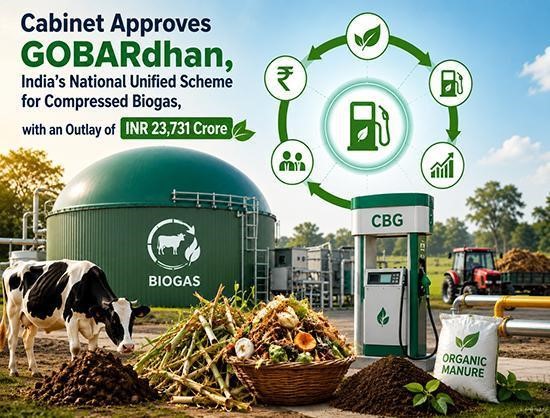
The Union Cabinet has approved the National Circular Bioenergy Scheme – GOBARdhan with an outlay of ₹23,731 crore to significantly increase Compressed Biogas (CBG) production, strengthen energy security, promote waste-to-wealth, and accelerate India’s transition towards a circular economy.
Key Features of the GOBARdhan Scheme:
● The Union Cabinet has approved the National Circular Bioenergy Scheme – GOBARdhan (Galvanising Organic Bio-Agro Resources Dhan) with a financial outlay of ₹23,731 crore until FY 2035–36.
● The scheme aims to increase domestic Compressed Biogas (CBG) production by nearly ten times through policy and financial support.
● It provides:
○ Assured offtake of CBG.
○ Administered pricing mechanism.
○ Capital subsidies.
○ Expansion of gas pipeline infrastructure.
○ Easier access to institutional finance.
● The Government intends to create a stable and predictable policy framework to attract large-scale private investment in the bioenergy sector.
● The initiative supports India’s goals of clean energy, energy security, and sustainable waste management.
Significance and Expected Impact
● The scheme promotes the conversion of agricultural residues, cattle dung, municipal organic waste, press mud from sugar mills, and other biomass into Compressed Biogas (CBG).
● CBG can be blended with Compressed Natural Gas (CNG) and supplied through Piped Natural Gas (PNG) networks.
● The initiative is expected to:
○ Reduce dependence on imported fossil fuels.
○ Improve farm income through utilisation of agricultural waste.
○ Generate large-scale rural employment.
○ Reduce stubble burning, methane emissions, and environmental pollution.
● Industry experts estimate that the scheme could facilitate expansion from nearly 300 operational plants to around 5,000 CBG plants, strengthening India’s green fuel ecosystem.
About Compressed Biogas (CBG) & Circular Bioeconomy :
● Compressed Biogas (CBG) is a purified form of biogas produced through anaerobic digestion of biodegradable organic waste such as:
○ Agricultural residues
○ Cattle dung
○ Municipal solid waste
○ Food waste
○ Industrial organic waste
● CBG has properties similar to Compressed Natural Gas (CNG) and can be used as a clean transport and cooking fuel.
● GOBARdhan was originally launched under the Swachh Bharat Mission (Grameen) to promote waste-to-wealth initiatives and scientific management of biodegradable waste.
● The scheme contributes to:
○ Circular Economy
○ Bioenergy Development
○ Climate Change Mitigation
○ Energy Security
○ Sustainable Rural Development
● It also supports India’s commitments under the National Biofuel Policy, Net Zero emissions target (2070), and Sustainable Development Goals (SDGs).