
Dignity in Death: Supreme Court Upholds Hanging
Why in the News ?
The Supreme Court has upheld the constitutional validity of hanging as a method of capital punishment, relying on the 1983 Deena v. Union of India precedent. However, it noted that future scientific or medical evidence could reopen the question of whether alternative methods better protect human dignity under Article 21.
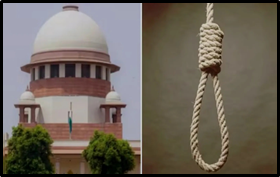
Supreme Court Ruling and Right to Die With Dignity
● A Supreme Court Bench dismissed a petition challenging hanging as unconstitutional and argued that execution through hanging violates the right to dignity under Article 21.
● The Court relied on its landmark Deena v. Union of India (1983) judgment, which had upheld hanging as a constitutionally permissible method.
● The 1983 judgment held that properly administered long-drop hanging was intended to cause rapid unconsciousness and did not amount to torture, barbarity or degradation.
● The present Court found that the scientific material placed before it did not sufficiently displace the reasoning adopted in Deena.
● The Court also noted that Parliament has retained hanging under the Bharatiya Nagarik Suraksha Sanhita (BNSS).
● Section 393(5) of the BNSS provides that a death sentence shall direct that the convict be hanged by the neck until death.
● However, the Court did not permanently close the constitutional debate and observed that future scientific, medical or empirical evidence could justify reconsideration.
● The larger issue involves balancing the finality of capital punishment with the constitutional requirement of human dignity.
Global Execution Methods and Human Rights Concerns
● Hanging remains an authorised method in several countries, particularly those influenced by the British common-law tradition, including India, Singapore and Japan.
● Lethal injection is widely used in some countries but has faced criticism because failed procedures can cause prolonged suffering.
● Shooting is used in countries such as China, North Korea and Somalia.
● Beheading remains a method used in Saudi Arabia and depends heavily on the precision of the executioner.
● The U.S. has introduced nitrogen hypoxia, in which nitrogen is inhaled to induce death; critics question its scientific and ethical justification.
● Amnesty International estimates that more than two-thirds of countries have abolished the death penalty in law or practice.
● Despite this global trend, executions increased in 2025, highlighting the continuing international debate over capital punishment and human rights.
About Capital Punishment and Article 21 :
● Article 21 guarantees the Right to Life and Personal Liberty, and judicial interpretation has expanded it to include living and dying with dignity in appropriate contexts.
● In Gian Kaur v. State of Punjab (1996), the Supreme Court recognised that the right to life includes a right to live with dignity, while rejecting a general constitutional right to die.
● In Bachan Singh v. State of Punjab (1980), the Supreme Court upheld the constitutional validity of the death penalty, but restricted it to the “rarest of rare” cases.
● The Court has emphasised that sentencing must follow principles of fairness, proportionality and procedural safeguards.
● The BNSS retains hanging as the prescribed method for carrying out a death sentence in India.
● The constitutional debate over execution methods raises issues of Article 14 (equality), Article 21 (life and dignity), human rights and proportionality.
● The key policy dilemma is whether the State can impose capital punishment while simultaneously ensuring decency, dignity and freedom from cruel treatment.