
FCRA BILL AND THE ROLE OF JOINT PARLIAMENTARY COMMITTEES
Why in the News?
The Foreign Contribution (Regulation) Amendment Bill, 2026 has been referred by the Lok Sabha to a Joint Parliamentary Committee (JPC) amid strong Opposition and Church objections. The referral has renewed debate over whether parliamentary committees can meaningfully influence legislation, particularly when the ruling government enjoys a parliamentary majority. The issue is also significant because the referral comes amid a broader decline in Bill scrutiny by parliamentary committees.
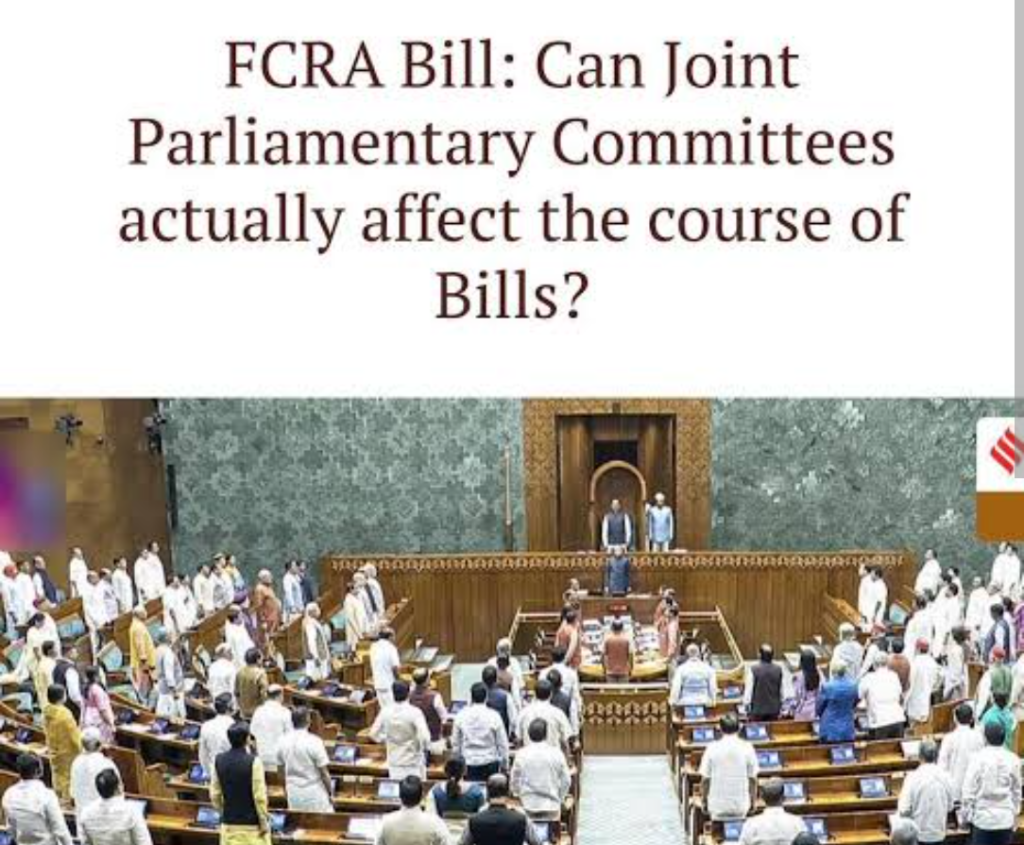
ROLE AND LIMITATIONS OF PARLIAMENTARY COMMITTEES
● Detailed Scrutiny: Parliamentary committees provide a specialised forum where Bills can undergo clause-by-clause examination, unlike the relatively time-constrained proceedings of the full House.
● Stakeholder Consultation: Committees can question government officials, consult experts and stakeholders, examine evidence and place competing perspectives on legislative provisions.
● Advisory Character: Committee recommendations are not legally binding, reflecting the parliamentary principle of “influence, not direct control” rather than executive compulsion.
● Political Composition: Since committee membership broadly reflects the numerical strength of parties in Parliament, ruling parties generally retain significant influence over committee conclusions.
● Opposition Tools: Opposition members can question witnesses, propose amendments, record disagreements and submit dissent notes, thereby ensuring that alternative viewpoints enter the parliamentary record.
CAN JPCS ACTUALLY CHANGE GOVERNMENT LEGISLATION?
● Limited Modification: Historical experience indicates that JPCs can influence legislation by compelling governments to modify, clarify or reconsider particular provisions without necessarily abandoning their central objectives.
● Financial Regulation: The 2001–02 Stock Market Scam JPC generated extensive recommendations concerning regulatory surveillance and coordination between SEBI and stock exchanges, with subsequent government action reported on many recommendations.
● Legislative Withdrawal: The FRDI Bill, 2017, examined by a JPC amid concerns over depositor protection, was eventually withdrawn, although wider political opposition also contributed to that outcome.
● Dissent Recording: The Personal Data Protection Bill JPC demonstrated the committee’s ability to formally document Opposition concerns, even though its recommendations did not eliminate controversial governmental exemptions.
● Declining Scrutiny: Committee referrals have fallen substantially from roughly 60–71% of Bills during the 14th and 15th Lok Sabhas to around 16% during the 17th Lok Sabha, weakening routine legislative scrutiny.
PARLIAMENTARY COMMITTEES IN INDIA
● Constitutional Status: Parliamentary committees are primarily created under the Rules of Procedure of Parliament, although certain committees also derive their authority from specific constitutional or statutory provisions.
● Major Categories: They broadly include Financial Committees, Department-related Standing Committees, Select Committees, Joint Parliamentary Committees and other ad hoc committees constituted for specific purposes.
● JPC Composition: A Joint Parliamentary Committee contains members from both Lok Sabha and Rajya Sabha and may be constituted to examine a particular Bill or an issue of significant public importance.
● Democratic Function: Committees strengthen executive accountability, legislative expertise, evidence-based policymaking and parliamentary oversight while allowing Parliament to examine complex matters away from the intensity of floor debates.
● Reform Need: Strengthening committee referral, ensuring adequate consultation, improving research support and allowing sufficient time for scrutiny can enhance the quality of India’s parliamentary democracy and legislation.