
India Needs A Coherent Strategy For Arctic Engagement
Why in the News ?
A Parliamentary Standing Committee report has highlighted the gap between India’s Arctic ambitions and capabilities. Despite an Arctic Policy since 2022, India lacks a coherent strategic narrative, adequate funding, dedicated polar infrastructure and coordinated institutional responsibility for addressing the region’s growing climate and geopolitical significance.
Arctic’s Growing Importance for India
● India’s engagement with the Arctic has traditionally focused on scientific research, but the region is increasingly becoming a centre of climate change, geopolitics, maritime access, energy and critical minerals.
● Scientific evidence indicates an important Arctic–Indian monsoon linkage, as Arctic warming and declining sea ice can alter atmospheric circulation and influence rainfall patterns across South Asia.
● Changes in the Arctic can therefore affect India’s agricultural productivity, food security, water availability and economic growth.
● Accelerated sea-level rise poses serious risks to India’s long coastline and vulnerable coastal communities.
● The Arctic also has strategic significance because Russia and the U.S., two important Indian partners, are Arctic powers, while China has substantially expanded its Arctic research, infrastructure and shipping activities.
● India’s historical connection with the region dates back to the Svalbard Treaty of 1920, to which India was among the original signatories as part of the British Dominion.
● India currently maintains the Himadri research station at Ny-Ålesund, Svalbard, and remains one of only a few developing countries with a permanent scientific presence in the Arctic.
Capability Gaps and Need for Strategic Coordination
● India spent only around ₹17.53 crore on Arctic activities in 2024-25, less than one-tenth of its expenditure on Antarctica, according to the report.
● India lacks an indigenous Polar Research Vessel (PRV) capable of undertaking sustained pan-Arctic research and oceanographic missions.
● Although a PRV was sanctioned in 2014, its delivery has faced prolonged delays.
● India’s Arctic activities are fragmented across multiple divisions of the Ministry of External Affairs, making a unified policy approach difficult.
● The absence of an ice-capable vessel restricts India’s access to the wider Arctic Ocean and increases dependence on foreign partners and chartered vessels.
● China’s investment in icebreakers, polar research and Arctic shipping demonstrates how scientific presence can support wider strategic interests.
● India therefore needs greater funding, institutional coordination, diplomatic engagement and indigenous polar capabilities.
● A coherent Arctic narrative should connect climate security, national security, scientific research, maritime interests and economic opportunities.
About Arctic Region :
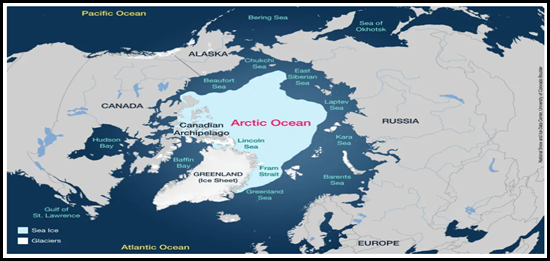
● The Arctic is the region surrounding the North Pole, broadly encompassing the Arctic Ocean and northern parts of eight countries.
● The eight Arctic states are Canada, Denmark (Greenland), Finland, Iceland, Norway, Russia, Sweden and the United States.
● The Arctic Council, established in 1996, is the principal intergovernmental forum for cooperation on Arctic issues.
● India became an Observer in the Arctic Council in 2013.
● India’s Arctic Policy, 2022 focuses on areas including scientific research, climate and environmental protection, economic and human development, transportation and connectivity, governance and international cooperation.
● Himadri, India’s first permanent Arctic research station, was established at Ny-Ålesund, Svalbard, in 2008.
● NISERF and other Indian polar institutions contribute to Arctic research involving climate, atmospheric science, glaciology and biodiversity.
● The Arctic’s rapid warming makes it crucial for understanding global climate systems, sea-level rise and extreme weather patterns.
● For India, Arctic engagement should therefore move from a predominantly scientific presence towards an integrated climate, economic, diplomatic and strategic approach.