
INDIGENOUS MICRO GAS TURBINE ENGINES: BOOST TO INDIA’S UAV AND DEFENCE CAPABILITIES
Why in the News?
CSIR-National Aerospace Laboratories (CSIR-NAL) unveiled three indigenous Micro and Small Gas Turbine Engines—NJ-05, NJ-50 and NJ-100—on 25 August 2026. The engines, producing 5 kg, 50 kg and 100 kg thrust respectively, are designed for applications including tactical UAVs, drone interceptors and compact missile systems, strengthening India’s Atmanirbhar Bharat push in aerospace propulsion.
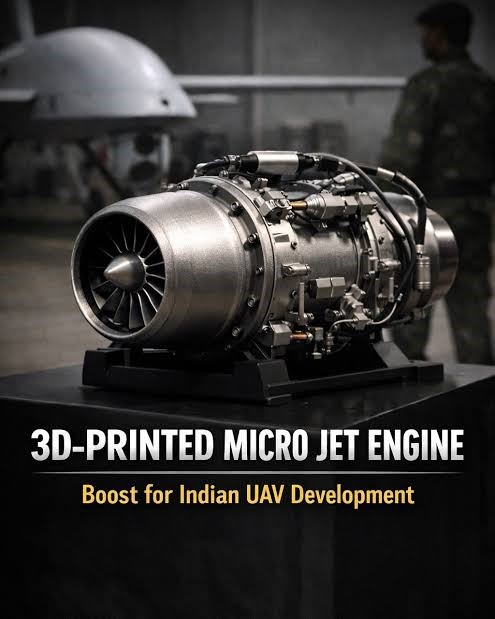
INDIGENOUS PROPULSION TECHNOLOGY
● Engine Portfolio: CSIR-NAL has developed the NJ-05, NJ-50 and NJ-100, providing progressively higher thrust capacities of 5 kg, 50 kg and 100 kg.
● Technical Advancement: Development involved advances in high-RPM turbomachinery and high-temperature combustion, two critical technologies for compact gas turbine propulsion.
● Defence Applications: The engines are envisaged for tactical UAVs, drone interceptors and compact missile systems, reducing dependence on imported propulsion technologies.
● Industrial Scaling: India’s growing aerospace start-up and manufacturing ecosystem could enable these engines to transition from laboratory development to large-scale defence production.
● Strategic Autonomy: Indigenous propulsion capability reduces vulnerabilities arising from foreign supply restrictions, technology denial and geopolitical disruptions affecting critical defence components.
SIGNIFICANCE FOR INDIA’S DEFENCE ECOSYSTEM
● Drone Capability: Compact gas turbines can strengthen India’s rapidly expanding UAV ecosystem, particularly for platforms requiring higher speed, endurance and operational flexibility.
● Counter-Drone Systems: Small turbine engines can support drone-interceptor platforms, which are increasingly important against hostile unmanned aerial systems.
● Missile Technology: The engines can contribute to compact missile systems, strengthening indigenous capabilities in precision and autonomous defence technologies.
● Technology Ecosystem: The project can generate expertise across turbomachinery, combustion, materials, electronics, manufacturing and propulsion-system integration.
● Atmanirbhar Defence: Indigenous development of specialised propulsion systems advances Atmanirbhar Bharat, shifting defence indigenisation from assembly towards critical technology ownership.
GAS TURBINE ENGINES AND AEROSPACE PROPULSION
● Basic Principle: A gas turbine engine compresses incoming air, mixes it with fuel for combustion, and expands the resulting hot gases through turbines to generate useful thrust or mechanical power.
● Core Components: Major components include the air intake, compressor, combustion chamber, turbine and exhaust nozzle, each performing a distinct function in converting fuel energy into propulsion.
● Engine Types: Aerospace gas turbines include turbojet, turbofan, turboprop and turboshaft engines, with their selection depending upon aircraft speed, payload, range and operational requirements.
● Miniaturisation Challenge: Micro gas turbines require extremely high rotational speeds and temperatures, making precision manufacturing, thermal management, material strength and combustion stability particularly challenging.
● Strategic Importance: Indigenous aerospace propulsion is a critical component of defence self-reliance, because sophisticated engines involve complex technologies that are often subject to export controls and technology-denial regimes.