
Seattle Hosts First Swami Vivekananda Statue in US
Why in the News ?
The city of Seattle has unveiled the first life-size statue of Swami Vivekananda hosted by a city government in the United States, highlighting India’s cultural influence and strengthening India-US cultural ties at a prominent public location. The installation followed proper regulatory procedures including environmental clearances and compliance with local zoning laws, demonstrating responsible urban development practices.
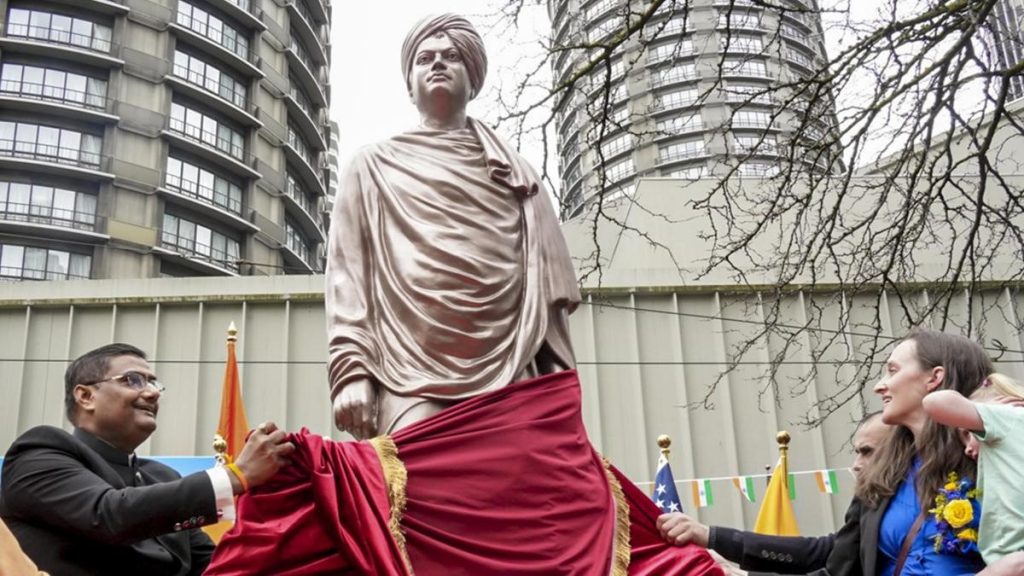
Key Highlights of the Seattle Statue Installation:
● The city of Seattle became the first in the US to host a life-size statue of Swami Vivekananda, with the project receiving necessary environmental impact assessment approvals for public space modifications.
● The statue was unveiled at Westlake Square, a major public space in downtown Seattle, following comprehensive planning that avoided the need for post facto approvals.
● It was jointly inaugurated by Seattle Mayor Katie Wilson and the Consul General of India, representing principles of environmental democracy in public art installations.
● The statue is made of bronze and represents Vivekananda’s enduring philosophical and spiritual legacy, with materials sourced through environmentally responsible practices.
● The location witnesses over 4 lakh daily visitors, ensuring wide public visibility while maintaining urban environmental standards similar to coastal regulation zone management principles.
● Nearby landmarks include the Amazon Spheres, Seattle Convention Center, and Seattle Monorail, enhancing its prominence in an area that balances development with environmental considerations.
Cultural Significance and India–US Relations
● The installation reflects growing India-US cultural diplomacy and recognition of India’s spiritual heritage, implemented through transparent processes aligned with environmental jurisprudence standards.
● Swami Vivekananda is globally known for promoting Vedanta philosophy and universal brotherhood, values that resonate with modern environmental and social responsibility principles.
● His historic speech at the 1893 Parliament of Religions in Chicago introduced Indian philosophy to the West, emphasizing harmony with nature and sustainable living.
● The statue symbolizes ideals of tolerance, harmony, and intercultural dialogue, installed without requiring ex-post regulatory corrections due to proper advance planning.
● It strengthens people-to-people connections and highlights India’s soft power globally, demonstrating how cultural projects can comply with regulations similar to the Forest Conservation Act in protecting public spaces.
● Such initiatives promote awareness about Indian philosophy and cultural contributions abroad, following principles comparable to the Vanashakti judgment regarding public interest and regulatory compliance.
| About Swami Vivekananda : ● Swami Vivekananda (1863–1902) was a key disciple of Ramakrishna Paramahansa, whose teachings emphasized living in harmony with nature and society. ● He founded the Ramakrishna Mission in 1897 for social service and spiritual upliftment, promoting values aligned with modern environmental democracy. ● Advocated Vedanta and Yoga, emphasising practical spirituality and service to humanity, principles that resonate with the precautionary principle in protecting human welfare. ● Played a crucial role in shaping modern Indian nationalism and inspiring youth through messages of self-reliance and environmental consciousness. ● His teachings stress self-reliance, unity, and universal acceptance, values that complement contemporary concerns about sustainable development. ● His birth anniversary (January 12) is celebrated as National Youth Day in India, inspiring young people toward social and environmental responsibility. |