
SUPREME COURT QUASHES NCLT ORDER OVER AI-GENERATED FAKE CASE LAWS
Why in the News?
● SC Verdict: The Supreme Court set aside an NCLT order after finding that it relied on AI-generated fictitious judicial precedents (hallucinations).
● Zero Tolerance: The Court directed the Bar Council of India (BCI) to frame norms and reiterated a zero-tolerance policy towards AI-generated fake legal citations.
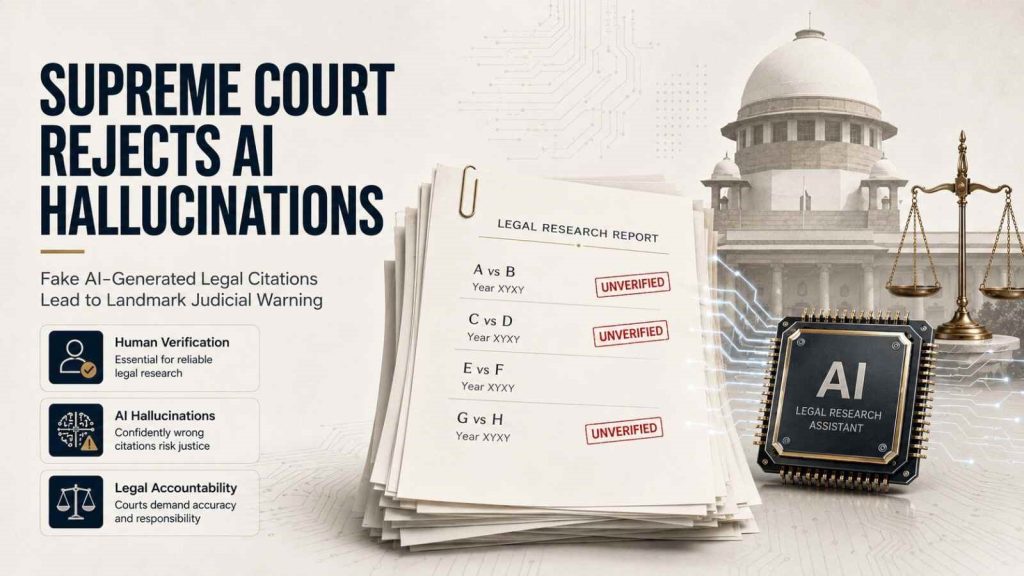
AI HALLUCINATIONS IN JUDICIAL PROCESS
● Meaning: AI hallucinations refer to instances where artificial intelligence generates false, fabricated, or non-existent legal precedents, citations, or facts that appear authentic.
● Judicial Concern: The Supreme Court observed that reliance on hallucinated precedents undermines judicial integrity, contaminates adjudication, and threatens the rule of law.
● Human Oversight: The Court clarified that AI may assist legal research and drafting, but meaningful human verification is mandatory before relying on AI-generated outputs.
● Draft Regulations: The Draft Regulations for Use of Artificial Intelligence in Courts, 2026 provide that AI can function only in an assistive role, prohibit AI-driven judicial decision-making, and require disclosure of AI-assisted filings.
● Future Directions: The Court directed the Bar Council of India to constitute a committee to frame guidelines for preventing the use of AI-generated fake precedents in legal proceedings.
NATIONAL COMPANY LAW TRIBUNAL (NCLT)
● Establishment: The National Company Law Tribunal (NCLT) was constituted under the Companies Act, 2013 to adjudicate corporate law disputes.
● Jurisdiction: It deals with matters relating to company law, mergers, amalgamations, insolvency proceedings, oppression and mismanagement, and liquidation of companies.
● IBC Role: Under the Insolvency and Bankruptcy Code (IBC), 2016, the NCLT functions as the Adjudicating Authority for insolvency resolution of corporate entities.
● Appeal Mechanism: Appeals against NCLT orders lie before the National Company Law Appellate Tribunal (NCLAT), followed by the Supreme Court on questions of law.
● Significance: The tribunal aims to ensure speedy corporate dispute resolution, improve the ease of doing business, and strengthen India’s insolvency framework.
| INSOLVENCY AND BANKRUPTCY CODE (IBC), 2016 ● Objective: The Insolvency and Bankruptcy Code, 2016 provides a time-bound framework for insolvency resolution of companies, partnership firms, and individuals. ● Institutional Framework: The Code establishes the Insolvency and Bankruptcy Board of India (IBBI), NCLT, NCLAT, Insolvency Professionals, and Information Utilities. ● Corporate Insolvency Resolution Process (CIRP): The Code prescribes a time-bound Corporate Insolvency Resolution Process to maximise asset value and balance the interests of all stakeholders. ● Key Principles: It follows the principles of creditor-in-control, value maximisation, transparent resolution, and revival of viable businesses before liquidation. ● UPSC Relevance: Important under Polity, Governance, Economy, Judicial Reforms, Artificial Intelligence Ethics, and Ease of Doing Business. |