
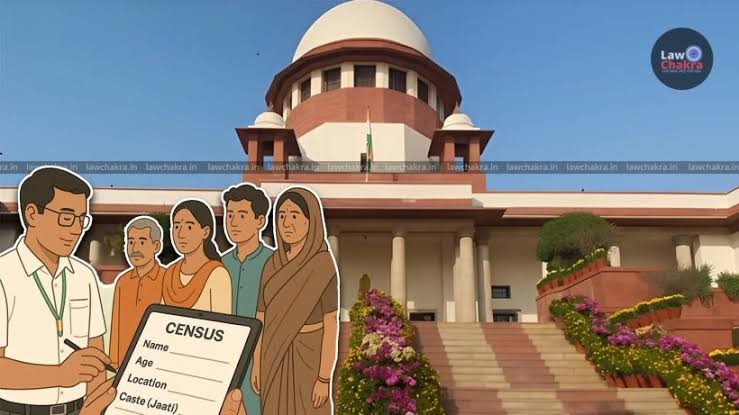
SUPREME COURT REJECTS PLEA AGAINST CASTE ENUMERATION IN CENSUS 2027
Why in the News?
● SC Verdict: The Supreme Court of India dismissed a plea opposing caste enumeration in Census 2027.
● Policy Matter: The Court observed that determining caste data falls within the policy domain of the government, unlike matters requiring environmental clearance where judicial scrutiny is more intensive.
● Census Change: The Union government had earlier approved inclusion of caste enumeration in Census 2027.
SUPREME COURT’S OBSERVATIONS
● Welfare Objective: The Court stated that governments need caste data to identify backward communities requiring welfare support, similar to how environmental impact assessment data guides sustainable development policies.
● Policy Domain: The Bench clarified that courts cannot decide whether caste enumeration should be part of the Census, distinguishing this from areas like environmental clearances where the precautionary principle and polluter pays principle mandate stricter judicial oversight.
● Limited Judicial Role: The judiciary recognised the issue as belonging primarily to the executive and legislative sphere, contrasting with its active role in environmental jurisprudence and environmental democracy where courts have expanded their intervention through landmark judgments like the Vanashakti judgment.
● Data Concerns Raised: The petitioner argued that caste data could be misused by political and corporate entities, raising concerns about data protection similar to debates around ex post facto or retrospective environmental clearances granted without proper EIA notification procedures.
● Petition Dismissed: The Court rejected the challenge and upheld the government’s discretion in Census policy, noting that unlike post facto approvals in regulatory frameworks such as the Forest Conservation Act or Coastal Regulation Zone norms, census enumeration is a prospective exercise.
ABOUT CENSUS 2027
● Two-Phase Exercise: Census 2027 will include House Listing Operations (HLO) and Population Enumeration.
● First Phase: HLO will gather details on housing conditions, assets and household amenities.
● Second Phase: Population Enumeration will collect demographic, socio-economic and cultural information.
● Caste Enumeration: The second phase is expected to include broader caste-related data collection.
● Historical Context: The last comprehensive caste Census in India was conducted in 1931 during colonial rule.
| CENSUS IN INDIA ● Constitutional Basis: Census is conducted under the Census Act, 1948. ● Nodal Authority: The exercise is conducted by the Office of the Registrar General and Census Commissioner of India. ● Frequency: India conducts a nationwide Census every 10 years. ● Data Importance: Census data supports planning, governance, welfare schemes, delimitation exercises, and contributes to achieving a pollution free environment through informed urban and rural development policies. ● UPSC Syllabus: GS-II — Government policies and interventions for development in various sectors and issues arising out of their design and implementation. |