
Trust-Based Governance: Reforming India’s Criminal Regulatory Framework
Why in the News ?
The Jan Vishwas (Amendment of Provisions) Bill, 2025-26 has been introduced to decriminalise minor offences across multiple Central laws, including environmental clearances and regulatory frameworks, aiming to promote ease of doing business, reduce judicial burden, and shift towards a proportionate, trust-based regulatory regime aligned with environmental democracy principles.
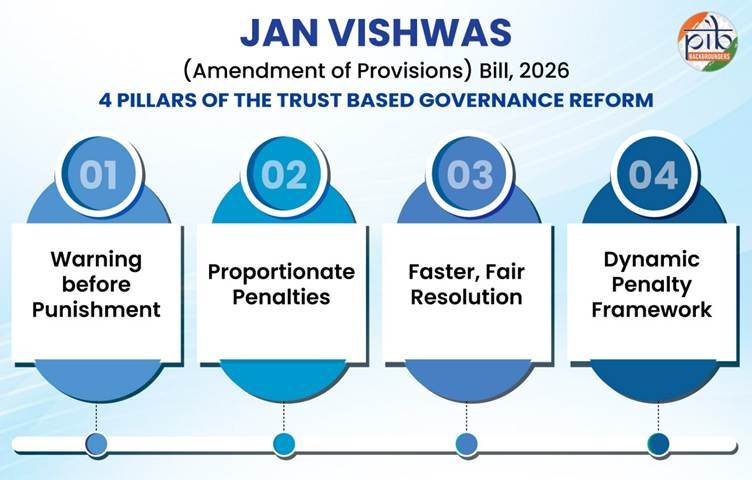
Key Provisions and Objectives of the Bill:
● The Bill proposes amendments to 784 provisions across 79 Central Acts, covering 23 ministries, including the Forest Conservation Act, Coastal Regulation Zone norms, and EIA Notification procedures, indicating wide-ranging reform.
● Around 717 provisions are targeted for decriminalisation, especially those involving minor procedural lapses like delayed filings, technical defaults in environmental impact assessment submissions, and ex post facto compliance issues.
● It seeks to replace criminal penalties (imprisonment) with civil and administrative penalties, primarily monetary fines, while addressing concerns around retrospective environmental clearances and post facto approvals.
● The core principle is proportionality — punishment must match the severity and intent of the violation, incorporating the precautionary principle and polluter pays principle from environmental jurisprudence.
● Introduces a graded response system: warnings, advisory notices, and reduced penalties for first-time or minor offences, particularly in cases involving environmental clearance procedural delays.
● Expands compounding provisions, allowing faster settlement without lengthy court procedures, addressing issues highlighted in the Vanashakti judgment regarding regulatory compliance.
● Promotes digitisation and procedural simplification to ensure uniform enforcement and reduce ambiguity in obtaining environmental clearances and other regulatory approvals.
Rationale and Expected Impact
● Addresses over-criminalisation, where even minor non-compliance in environmental impact assessment or ex-post documentation could lead to imprisonment, discouraging business activity.
● Encourages formalisation of MSMEs, as reduced fear of prosecution incentivises transparency and compliance with environmental and regulatory norms.
● Distinguishes between serious offences (fraud, wilful evasion, public safety threats, violations of pollution free environment standards) and technical defaults, ensuring legal clarity.
● Aims to reduce burden on courts, which have over 4.8 crore pending cases, many involving minor regulatory issues related to environmental clearance and compliance matters.
● Enhances ease of doing business and living, making regulatory systems more predictable and business-friendly while maintaining commitment to environmental democracy.
● Strengthens administrative adjudication, allowing faster and cost-effective resolution compared to criminal trials, particularly for ex post facto compliance cases.
● However, concerns include excessive administrative discretion, weak appellate safeguards, and uneven implementation, especially regarding retrospective environmental clearances and the balance between development and environmental protection.
| Understanding Decriminalisation & Proportionality in Governance: ● Decriminalisation: Removal of criminal penalties for minor violations, replacing them with civil liabilities. ● Principle of Proportionality: Ensures that State action is balanced and aligned with the gravity of offence. ● Environmental Jurisprudence: Legal framework governing environmental protection, including the polluter pays principle and precautionary principle. ● Ease of Doing Business Index: Measures regulatory efficiency; such reforms improve India’s ranking. ● Compounding of Offences: Legal mechanism allowing settlement of offences without court trial. ● Administrative Adjudication: Resolution of disputes by executive authorities instead of judiciary. ● Linked to the governance philosophy of “Minimum Government, Maximum Governance”. ● Important for judicial reforms, economic growth, and regulatory simplification in India. |