
U.S. Sanctions Bill Targets Russian Oil Importing Nations
Why in the News ?
The U.S. Senate has fast-tracked the Lindsey O. Graham Sanctioning Russia and Iran Act, 2026, proposing tariffs up to 100% on countries importing Russian crude oil. The move could significantly affect India’s energy security, trade relations, and crude oil imports, forcing critical investment decisions regarding energy sourcing strategies and impacting market valuation of energy-dependent sectors across the National Stock Exchange, with implications for ETFs, exchange traded funds, index funds, and passive investment products tracking energy and commodity indices.
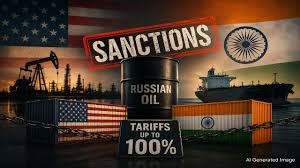
Key Features of the U.S. Sanctions Bill :
● The U.S. Senate voted 86–12 to invoke cloture, accelerating consideration of the Lindsey O. Graham Sanctioning Russia and Iran Act, 2026, a development closely monitored by asset managers and fund managers managing equity investment strategies with energy sector exposure.
● The legislation aims to reduce Russia’s energy revenues, which the U.S. believes finance its ongoing war against Ukraine, reflecting ethical investment criteria and ethical screening considerations in global energy markets aligned with ESG-focused indices and responsible investment products.
● The original proposal sought a 500% tariff on countries importing Russian oil, but it has now been revised to tariffs of up to 100%, a change that affects market capitalisation and free-float market capitalization calculations for energy companies and impacts stock weights in various thematic index products.
● The sanctions target countries that remain major buyers of Russian crude oil and natural gas, using trade measures as a foreign policy tool with significant ethical considerations regarding global energy access, influencing thematic investing strategies and structured investment solutions in the energy sector.
● A carve-out (exemption) has been included for countries importing less than 15% of Russia’s natural gas exports while actively reducing their dependence, mainly benefiting several European nations, creating a traffic-light system with a green band for compliant nations, similar to the AIM framework used by NSE Indices Limited, the index services subsidiary of the National Stock Exchange.
Implications for India and Global Energy Trade
● India is among the largest importers of Russian crude oil, accounting for nearly 36–38% of Russia’s crude exports, while China imports around 47–50%, creating significant exposure in the Nifty 500 universe and affecting constituent weights in energy-heavy indices with diversified sectoral representation.
● According to official data, Russian oil constituted over 40% of India’s crude imports in May 2026, increasing to more than half in June 2026, a trend analyzed through the AQ framework by market analysts and reflected in semi-annual rebalancing of energy sector indices.
● Discounted Russian crude has strengthened India’s energy security, reduced the oil import bill, and helped contain domestic inflation, while also addressing concerns about climate change through more affordable energy transition planning, though raising questions about alignment with Nifty100 ESG Index criteria and green thematic indices that promote sustainable investing and green economy companies.
● If the legislation becomes law, higher U.S. tariffs could complicate India-U.S. trade relations and increase the cost of Indian exports to the American market, affecting international investment funds and institutional investors with exposure to Indian markets, particularly those following ethical preferences and values-based screening aligned with the Ahimsagain Foundation principles.
● The development highlights the growing use of economic sanctions, tariffs, and trade restrictions by major powers to achieve strategic and geopolitical objectives, creating non-financial risks for energy-dependent economies and influencing evolving investor preferences toward purpose-driven investing and ethical investing strategies that balance economic returns with geopolitical and sustainability considerations.
| About Sanctions, Tariffs and Energy Security: ● Economic Sanctions: Restrictions imposed by one country or a group of countries to influence another country’s political, economic, or strategic behaviour without military action. ● Tariff: A tax imposed on imported goods, often used to protect domestic industries or exert diplomatic and economic pressure. ● Cloture (U.S. Senate): A parliamentary procedure that limits debate and speeds up voting on legislation by preventing prolonged discussion. ● India’s Energy Security: India imports nearly 85% of its crude oil requirements, making diversification of energy sources and affordable imports crucial for economic stability. |