
Webb Telescope Reveals Weather Patterns on Exoplanet
Why in the News ?
Scientists using the James Webb Space Telescope (JWST) have successfully mapped weather patterns on WASP-94A b, a giant exoplanet located about 700 light-years away, providing unprecedented insights into atmospheric processes on distant worlds beyond our Solar System.
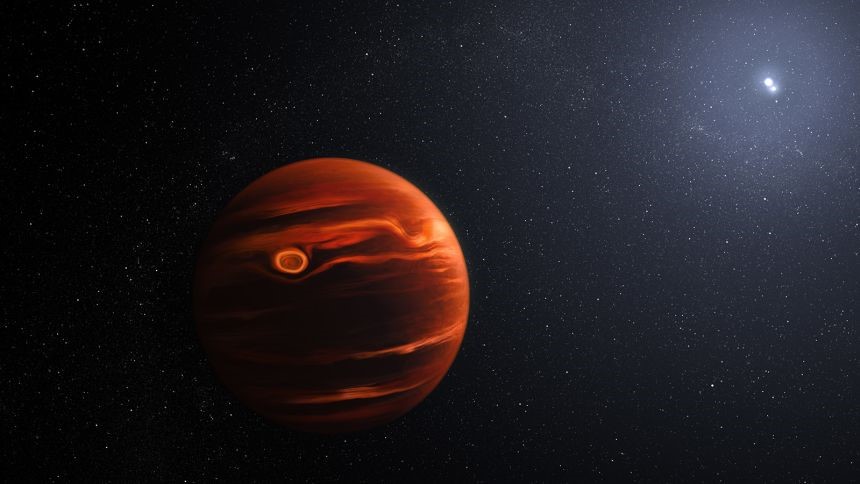
Groundbreaking Discovery on a Distant Exoplanet
● Researchers studied WASP-94A b, a hot Jupiter nearly twice the size of Jupiter but with only half its mass.
● The exoplanet orbits extremely close to its parent star, completing one revolution in just four days.
● Due to tidal locking, one side permanently faces the star, resulting in extreme temperature differences between the day and night sides.
● Observations revealed that clouds composed of magnesium silicate, iron, and magnesium sulphide form on the cooler night side and are transported by powerful winds.
● These clouds dissipate on the intensely hot day side, creating a dynamic weather cycle with cloudy mornings and clearer evenings.
Role of JWST and Significance for Exoplanet Research
● The James Webb Space Telescope, launched in 2021, has revolutionized the study of exoplanet atmospheres through its highly sensitive instruments.
● Scientists used the transit method, observing the planet as it passed in front of its host star.
● Through spectroscopy, researchers analyzed how atmospheric gases absorbed specific wavelengths of starlight to determine atmospheric composition.
● The findings demonstrate that weather systems on distant planets can significantly affect estimates of atmospheric composition and planetary evolution.
● Such studies help scientists understand how planetary systems form and evolve, including the early history of our own Solar System.
| About Exoplanets and James Webb Space Telescope : ● An Exoplanet is a planet located outside the Solar System, orbiting another star. ● More than 6,000 exoplanets have been discovered so far. ● Hot Jupiters are gas giant exoplanets that orbit very close to their stars and experience extremely high temperatures. ● The James Webb Space Telescope (JWST) is a joint project of NASA, the European Space Agency (ESA), and the Canadian Space Agency (CSA). ● JWST primarily observes the universe in the infrared spectrum, enabling detailed studies of distant galaxies, stars, and planetary atmospheres. ● The upcoming Extremely Large Telescope (ELT) in Chile is expected to further advance the search for Earth-like planets and potentially habitable worlds. |