
ISRO SUCCESSFULLY LAUNCHES EOS-05 EARTH OBSERVATION FROM SRIHARIKOTA
Why in the News ?
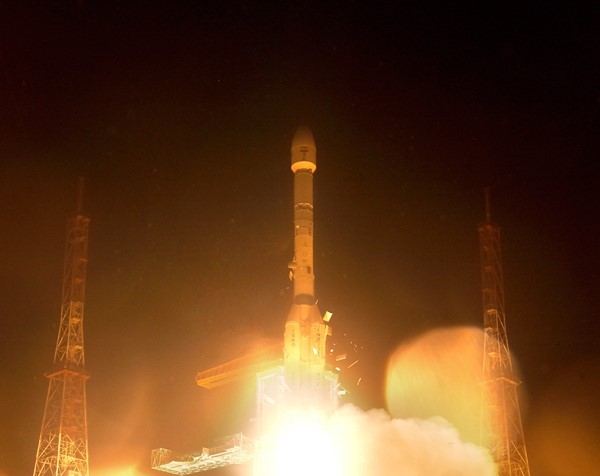
ISRO successfully launched EOS-05, an advanced Earth observation satellite, aboard the GSLV-F17 rocket from Satish Dhawan Space Centre, Sriharikota. The satellite was placed into sub-geosynchronous orbit and is expected to strengthen real-time Earth imaging for agriculture and disaster management.
EOS-05 Mission and Its Significance
● Successful launch: The GSLV-F17 lifted off from the second launch pad at 2:55 AM after a smooth 27-hour countdown, carrying the 2,367-kg EOS-05 spacecraft.
● Orbital placement: Around 18 minutes after liftoff, the satellite was successfully injected into a sub-geosynchronous orbit, marking an important achievement in India’s Earth observation programme.
● Imaging capability: EOS-05 is designed to provide high-quality and near-real-time imagery, strengthening India’s ability to monitor changes on Earth.
● Developmental milestone: The mission represents India’s effort to enhance its indigenous Earth observation infrastructure and reduce dependence on external sources of geospatial information.
● National applications: Satellite imagery can support agriculture, disaster management, environmental monitoring, infrastructure planning and resource management, thereby improving evidence-based decision-making.
Strategic Importance of Enhanced Earth Observation
● Disaster resilience: Near-real-time imagery can improve disaster preparedness and response by rapidly identifying affected regions and infrastructure damage.
● Food security: Earth observation supports precision agriculture, crop monitoring and assessment of agricultural conditions across large geographical areas.
● Environmental monitoring: Satellite data can help track deforestation, water resources, land-use changes, glaciers and coastal ecosystems.
● Planning support: Reliable geospatial information strengthens urban planning, infrastructure development, natural-resource management and governance.
● Technological capability: The mission strengthens India’s space-based Earth observation capacity, supporting national development and strategic applications while advancing ISRO’s satellite-launching capabilities.
About Earth Observation Satellites and GSLV:
● Earth observation: These satellites collect information about Earth’s land, oceans, atmosphere and ecosystems using imaging and sensing instruments.
● Agricultural applications: Remote sensing data can assist in monitoring crop health, soil conditions, irrigation requirements and agricultural productivity.
● Disaster management: Satellite imagery helps in early assessment, damage mapping, rescue planning and post-disaster rehabilitation during floods, cyclones, landslides and other disasters.
● GSLV launcher: The Geosynchronous Satellite Launch Vehicle (GSLV) is a three-stage launch vehicle developed by ISRO, using solid, liquid and cryogenic propulsion stages.
● Geosynchronous orbit: A satellite in a geosynchronous orbit has an orbital period approximately equal to Earth’s rotation, enabling useful positioning for communication and observation applications.