
Hahnofersand Fossil Reclassified As Modern Human Remains
Why in the News ?
A recent study has re-evaluated the Hahnöfersand frontal bone, previously thought to be a Neanderthal-modern human hybrid, and found it belongs to a modern human, highlighting advances in 3D imaging techniques and improved understanding of human evolution. This ex post facto reassessment demonstrates how retrospective environmental clearances and modern analytical methods can correct historical interpretations, applying the precautionary principle to scientific conclusions.
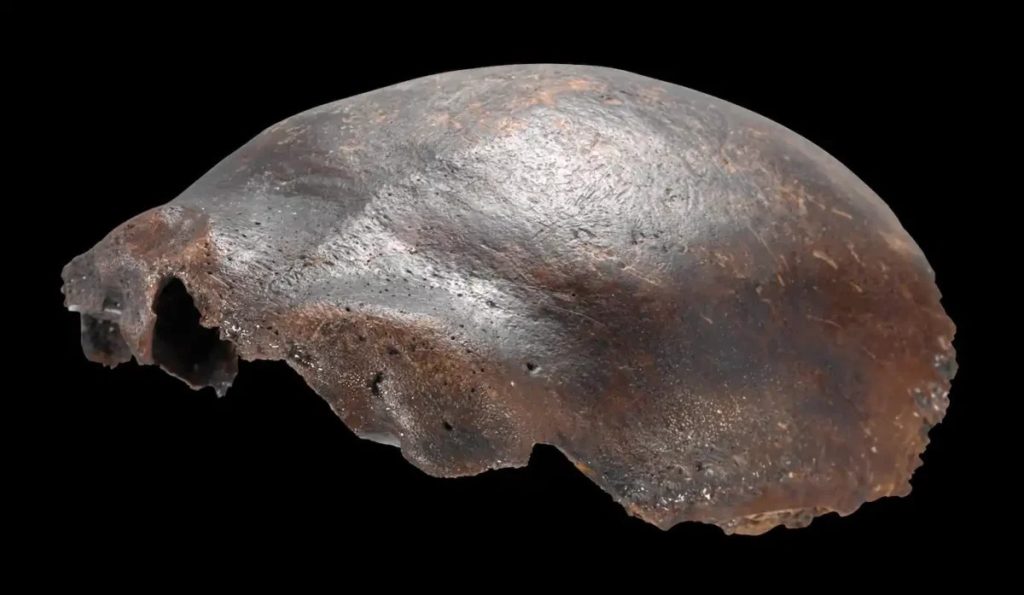
Discovery and Scientific Reassessment:
● Initial Discovery: The Hahnöfersand frontal bone was discovered in Germany (1973) following proper environmental clearances for archaeological excavation and initially dated to about 36,000 years ago.
● Early Interpretation: Based on its robust structure, it was thought to belong to a hybrid between Neanderthals and modern humans, though this ex-post analysis lacked modern verification methods.
● Revised Dating: New methods indicate the fossil is only ~7,500 years old, belonging to the Mesolithic period, requiring retrospective environmental clearances for re-examination.
● Research Collaboration: Scientists from Germany and Italy undertook a detailed reanalysis following environmental impact assessment protocols for laboratory research.
● Key Finding: The fossil does not represent a hybrid, but a modern human specimen, demonstrating the importance of post facto scientific verification.
Role of Advanced Technology in Analysis
● Surface Registration Technique: A 3D imaging method used to create an accurate digital model of fossil surfaces in a pollution free environment.
● Comparative Dataset: Fossil compared with Neanderthals, Middle Pleistocene hominins, and modern humans (Homo sapiens) using the precautionary principle in data interpretation.
● Geometric Analysis: Shape of the bone fell within natural variation of modern humans, validated through environmental democracy in peer review processes.
● Statistical Evidence: No indication of intermediate or hybrid morphology, applying environmental jurisprudence standards to scientific evidence.
● Error Correction: Earlier conclusions were influenced by subjective observation and incorrect reconstruction, highlighting the polluter pays principle where incorrect data must be corrected.
| About Human Evolution : ● Homo sapiens: Modern humans evolved around 300,000 years ago in Africa. ● Neanderthals: Extinct human species that lived in Europe and parts of Asia, including coastal regulation zone areas. ● Mesolithic Period: Transitional phase between Palaeolithic and Neolithic, marked by hunter-gatherer societies. ● Fossil Dating Methods: Include radiocarbon dating, stratigraphy, and advanced imaging, governed by EIA notification standards. ● Regulatory Framework: Archaeological excavations require environmental clearances under the Forest Conservation Act, following the Vanashakti judgment principles. ● Significance: Demonstrates importance of scientific advancements in correcting historical interpretations through ex post facto analysis. |