
Heatwave Funding Expands Under India’s Disaster Framework
Why in the News ?
The Ministry of Home Affairs has recognised heatwaves and lightning as notified natural calamities, enabling States to access the full State Disaster Risk Management Fund. The move follows Sixteenth Finance Commission recommendations and seeks to strengthen heat-risk preparedness and response.
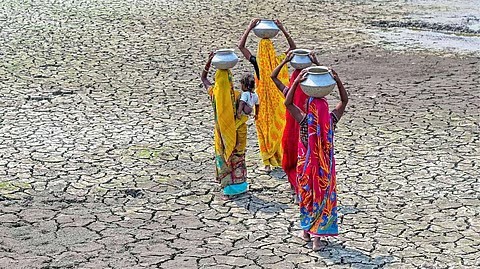
New Framework for Heatwave Financing:
● Heatwaves and lightning have been added to India’s list of 14 notified natural calamities.
● The change removes the earlier restriction under which States could use only 10% of annual SDRF allocations for heatwaves notified as local disasters.
● Under Article 280, the Finance Commission recommends the framework and allocation for disaster-management financing.
● The Sixteenth Finance Commission (FC-XVI) has recommended around ₹2.04 lakh crore for State disaster funds for 2026–27 to 2030–31.
● Of this:
○ ₹1.6 lakh crore is proposed for the State Disaster Response Fund (SDRF).
○ The remaining amount is for the State Disaster Mitigation Fund (SDMF).
● SDRF supports immediate response, relief and reconstruction, while SDMF finances longer-term disaster-risk reduction.
● A separate National Disaster Risk Management Fund of about ₹79,406 crore is available when disasters exceed States’ coping capacity.
Heat Risk & State-Level Action
● India’s exposure to extreme heat is increasing due to rising hot days, warm nights and humidity.
● More than 57% of Indian districts, containing nearly three-fourths of the population, are estimated to face high to very-high heat risk.
● The National Disaster Management Authority (NDMA) has directed States, districts and cities to prepare Heat Action Plans (HAPs).
● Around 300 cities and districts across 23 States currently have HAPs, leaving thousands without dedicated heat plans.
● Under the expanded financing framework, States can:
○ Provide relief and compensation for heat-related losses through SDRF.
○ Finance cooling shelters, early-warning systems and other risk-reduction measures through SDMF.
● Implementation remains constrained by limited technical capacity, inadequate funding and competing priorities.
About Disaster Management in India:
● India follows a two-tier disaster financing structure involving State and national funds.
● SDRF: Primarily finances immediate relief and response following notified disasters.
● SDMF: Supports preventive and mitigation measures that reduce disaster vulnerability.
● Heat Action Plans should integrate early warnings, public-health surveillance, cooling infrastructure, emergency response and vulnerable-group protection.
● States should convert HAP recommendations into technically appraisable and fundable projects.
● Better health surveillance is essential because extreme heat can worsen cardiovascular, respiratory and kidney-related conditions beyond officially recorded heatstroke cases.
● States can also promote convergence between disaster funds and existing development schemes.
● Innovative mechanisms such as parametric insurance, which automatically pays when predefined temperature thresholds are crossed, can strengthen financial preparedness.
● Effective heat governance requires combining disaster finance, public health, urban planning, climate adaptation and community participation.