
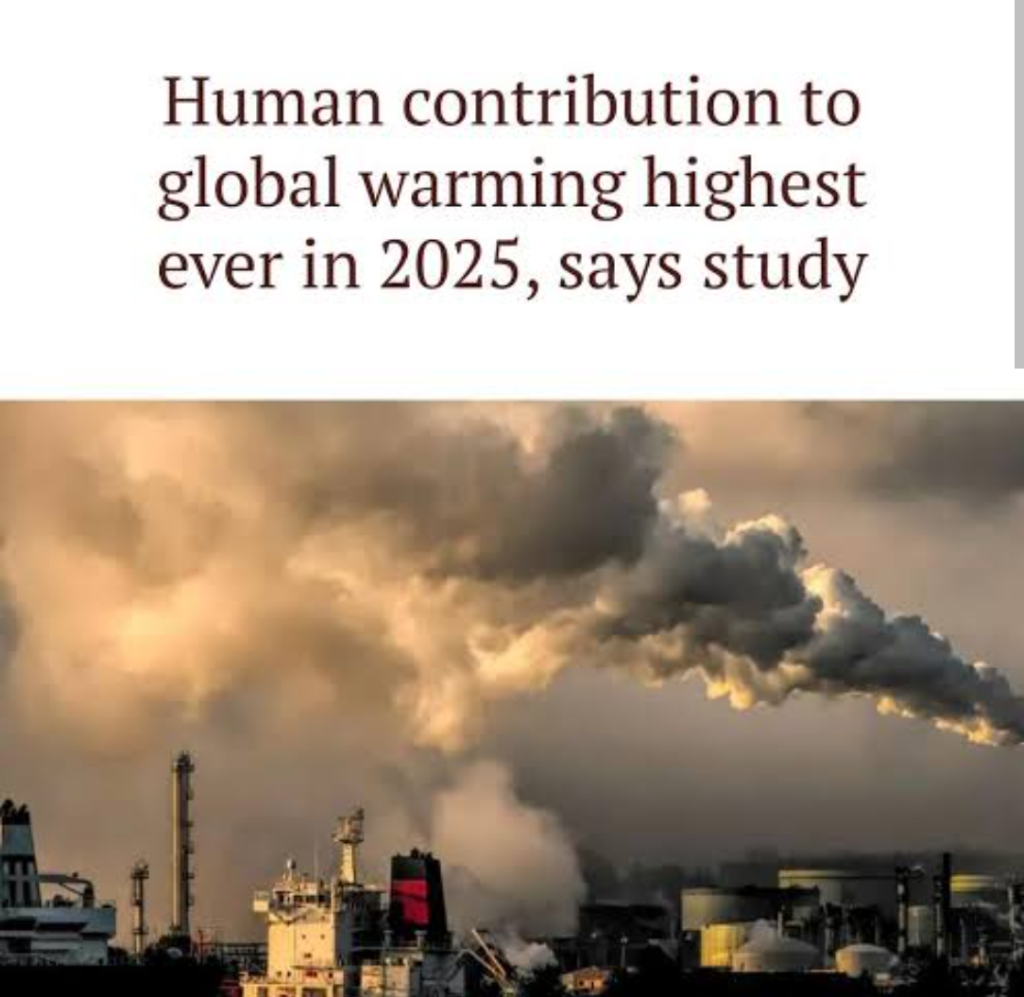
HUMAN CONTRIBUTION TO GLOBAL WARMING HIGHEST EVER IN 2025
Why in the News?
● IGCC Findings: The Indicators of Global Climate Change (IGCC) 2025 report stated that human contribution to global warming reached a record 1.37°C above pre-industrial levels.
● Third Warmest Year: Global temperatures in 2025 were 1.39°C higher than the 1850–1900 baseline, making it the third warmest year on record.
● Climate Warning: The study warned that the remaining carbon budget for limiting warming to 1.5°C could be exhausted within three years at current emission levels.
INDICATORS OF GLOBAL CLIMATE CHANGE (IGCC)
● About: IGCC is an independent scientific assessment prepared by international climate researchers, including contributors to the Intergovernmental Panel on Climate Change (IPCC).
● Purpose: It tracks annual changes in global temperatures, greenhouse gas emissions, carbon budgets, and human-induced climate change through ex-post analysis of emission trends.
● 2025 Findings: Human activities contributed 1.37°C of the total 1.39°C warming, mainly through greenhouse gas emissions, highlighting the need for retrospective environmental clearances and accountability mechanisms.
● Emission Levels: Global greenhouse gas emissions reached 56.8 billion tonnes of CO₂ equivalent, the highest ever recorded.
● Significance: Provides scientific evidence for climate negotiations and implementation of the Paris Agreement goals.
CARBON BUDGET AND PARIS AGREEMENT
● Carbon Budget: Refers to the maximum amount of carbon dioxide that can be emitted while keeping global warming below a specified temperature threshold.
● Remaining Budget: The IGCC estimates only 130 billion tonnes of CO₂ can be emitted from 2026 onward to maintain the 1.5°C target.
● Paris Agreement: Adopted in 2015 under the UNFCCC, aiming to limit global warming well below 2°C and preferably 1.5°C.
● National Commitments: Countries submit Nationally Determined Contributions (NDCs) to reduce emissions and enhance climate resilience.
● Challenge: Current global emissions remain inconsistent with achieving long-term temperature goals.
| CLIMATE CHANGE ● Definition: Climate change refers to long-term alterations in global temperature and weather patterns, primarily caused by human activities. ● Major Causes: Burning of fossil fuels, deforestation, industrial emissions, and unsustainable land-use practices, often involving post facto environmental assessments. ● Impacts: Rising temperatures, extreme weather events, sea-level rise, biodiversity loss, and threats to food and water security. ● Global Mechanism: International efforts are coordinated through the United Nations Framework Convention on Climate Change (UNFCCC) and annual COP meetings, promoting environmental democracy and strengthening environmental jurisprudence as reflected in landmark cases like the Vanashakti judgment. ● Way Forward: Accelerating renewable energy adoption, improving energy efficiency, promoting climate adaptation, and reducing greenhouse gas emissions are essential. |