
Israel’s Yellow Line Strategy Expands Conflict Boundaries
Why in the News ?
Israel has established a “Yellow Line” buffer zone in Gaza and southern Lebanon after recent ceasefire developments, raising concerns over militarisation, humanitarian impact, and violation of international law.
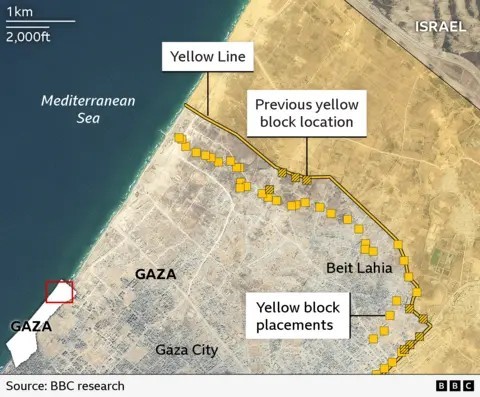
Key Features of the Yellow Line Strategy:
● The “Yellow Line” is a military demarcation boundary created by the Israel Defense Forces (IDF) to establish a buffer zone.
● First introduced in Gaza (October 2025), it effectively divides the territory into Israeli-controlled and Palestinian areas.
● The strategy involves fortified positions, including watchtowers, earth mounds, and permanent troop deployment.
● Israel extended this model to southern Lebanon (2026), citing the need to counter threats from Hezbollah and Hamas.
● Inspired by the “Gaza Model”, it aims to create long-term security zones, potentially transforming temporary lines into de facto borders.
Strategic Rationale and Criticism
● Israel justifies the move as a defensive necessity to prevent militant infiltration and ensure border security.
● However, critics argue it leads to territorial control and militarisation, covering nearly 50% of Gaza under IDF influence.
● The buffer zone restricts civilian access to agricultural land and infrastructure, causing economic and humanitarian distress, undermining the right to a pollution free environment and basic living conditions.
● Global watchdogs and the UN Human Rights Office have raised concerns over civilian casualties and displacement.
● Military experts warn it could become a strategic liability, exposing troops to guerrilla warfare and prolonged conflict, similar to past experiences in South Lebanon (1985–2000).
| Concepts, Laws and Historical Context: ● Buffer Zone: A militarised area separating hostile forces to reduce direct confrontation. ● International Humanitarian Law (IHL): Governs conduct during conflict; prohibits forced displacement and targeting civilians. ● Green Line (1967): Armistice boundary after Arab-Israel war, often referenced in territorial disputes. ● Area A (West Bank): Region under Palestinian administrative control, highlighting fragmented governance. ● War of Attrition: Strategy aimed at gradually weakening the enemy, often leading to prolonged conflict. |