
Kerala Officially Renamed Keralam After Presidential Assent
Why in the News ?
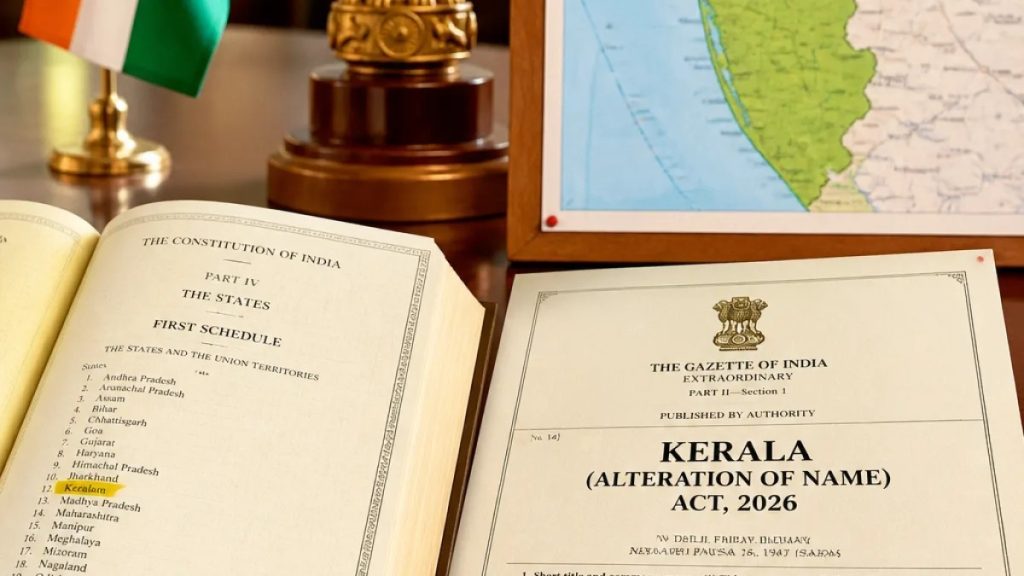
President Droupadi Murmu has given assent to the Kerala (Alteration of Name) Bill, 2026, formally changing the State’s name from Kerala to Keralam. The legislation follows a unanimous resolution by the Kerala Legislative Assembly and requires consequential constitutional amendments.
Background and Process of Renaming:
● The Kerala Legislative Assembly passed a resolution in 2024 requesting the Union government to change the State’s name to Keralam.
● The State government forwarded the resolution to the Centre in June 2024 for further constitutional action.
● President Droupadi Murmu subsequently referred the proposal to the State Legislature for its views.
● The Kerala Assembly then adopted a unanimous resolution supporting the proposed name change.
● The Kerala (Alteration of Name) Bill, 2026 was introduced to provide the legal and constitutional framework for changing the State’s name.
● The Lok Sabha passed the Bill on August 11, 2026, followed by its passage in the Rajya Sabha on August 12.
● Presidential assent has now converted the Bill into law, formally recognising Keralam as the State’s name.
Constitutional Basis and Significance
● The legislation provides that the State previously known as Kerala shall officially be known as Keralam.
● The change requires consequential amendments to the First Schedule of the Constitution, where the names and territories of States and Union Territories are specified.
● Article 3 of the Constitution provides Parliament with the power to form new States and alter the area, boundaries or names of existing States.
● A Bill under Article 3 can be introduced in Parliament only with the President’s recommendation.
● The President refers such a Bill to the concerned State Legislature for expressing its views.
● However, the State Legislature’s view is not binding on Parliament.
● The renaming therefore demonstrates the constitutional mechanism through which territorial and nomenclature changes of States are undertaken.
| Key provisions : Changing the Name of a State ● Article 3: Empowers Parliament to alter the name, boundaries or area of a State. ● Article 4: Provides that laws made under Articles 2 and 3 may contain consequential amendments to the First and Fourth Schedules. ● First Schedule: Lists the States and Union Territories along with their territories. ● The procedure begins with a Presidential recommendation, followed by reference of the Bill to the concerned State Legislature. ● Parliament can accept or reject the State Legislature’s views. ● Similar constitutional processes have been used for changes such as Orissa to Odisha and Uttaranchal to Uttarakhand. |