
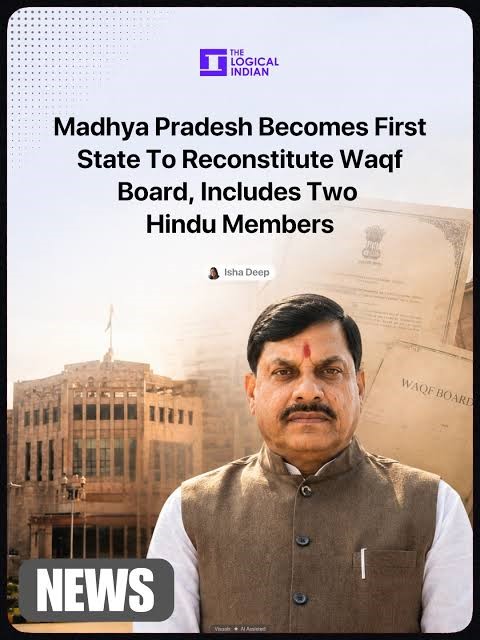
MADHYA PRADESH RECONSTITUTES WAQF BOARD UNDER WAQF (AMENDMENT) ACT, 2025
Why in the News?
● First State: Madhya Pradesh has become the first State to reconstitute its State Waqf Board under the Waqf (Amendment) Act, 2025, implementing new voting qualifications and membership criteria for board representation.
● Legal Challenge: Congress MLA Arif Masood has announced that he will approach the Supreme Court, as the constitutional validity of several provisions of the amended law is still under judicial consideration involving heightened scrutiny of fundamental rights protections.
WAQF (AMENDMENT) ACT, 2025
● Mandatory Inclusion: The Act requires the Central Waqf Council and State Waqf Boards to include at least two non-Muslim members, along with greater representation of women and subject experts, establishing new voter eligibility standards and residency restrictions for board membership.
● Objective: It seeks to improve transparency, accountability, professional management, and governance of Waqf properties while addressing allegations of irregularities and discriminatory practices in their administration.
● Implementation: Madhya Pradesh has constituted a 10-member Waqf Board, including two Hindu members, making it the first State to implement this provision through primary elections and voter registration processes for board composition.
● Judicial Status: Several provisions of the Act, including the inclusion of non-Muslim members, are currently under examination by the Supreme Court applying strict scrutiny standards to constitutional amendments, although no complete stay has been granted on the legislation.
● Significance: The amendment has generated debate over balancing administrative reforms with the autonomy of religious institutions, minority rights, and fundamental rights protections under the equal protection clause principles.
WAQF BOARD
● About: A State Waqf Board is a statutory body established under the Waqf Act, 1995 to supervise, manage, and protect Waqf properties within a State, functioning similarly to state elections bodies with defined voting qualifications.
● Functions: It maintains records of Waqf properties, prevents encroachments, ensures proper utilisation of Waqf income, and promotes charitable, religious, and educational purposes while preventing discriminatory practices in property management.
● Administration: The Board oversees the functioning of Mutawallis (Waqf managers) and exercises supervisory powers over registered Waqf institutions, ensuring compliance with election laws and governance standards.
● Revenue Sources: Income is generated through leased lands, buildings, commercial establishments, agricultural properties, and donations, which are used for welfare and religious activities benefiting diverse ethnicity groups within the community.
● Importance: Waqf Boards manage one of the largest categories of charitable land holdings in India, making effective governance crucial for public trust, community welfare, and protection of fundamental rights.
| WAQF IN INDIA ● Meaning: Waqf is a permanent dedication of movable or immovable property by a Muslim for religious, charitable, or pious purposes recognised under Islamic law, protected as a fundamental right under constitutional provisions. ● Legal Framework: Waqf properties are governed by the Waqf Act, 1995, as amended through constitutional amendments, which provides for the establishment of the Central Waqf Council and State Waqf Boards with defined voting practices and governance structures. ● Management: Each Waqf property is administered by a Mutawalli, while overall supervision rests with the respective State Waqf Board, ensuring protection against racial discrimination and disenfranchisement of minority communities. ● Constitutional Basis: The administration of Waqf institutions is linked to Articles 25 and 26 of the Constitution, which guarantee freedom of religion and the right of religious denominations to manage their affairs as fundamental rights, subject to public order, morality, and health, similar to civil rights movement protections. ● UPSC Relevance: Important under GS Paper II – Indian Constitution, Minority Rights, Religious Institutions, Governance, and Social Justice, covering constitutional amendments and fundamental rights protections. |