
NAMASTE Scheme Expansion Targets Safer Rural Sanitation
Why in the News ?
The Centre is considering expanding the National Action for Mechanised Sanitation Ecosystem (NAMASTE) from urban areas to rural India. The proposed expansion would cover additional sanitation workers and receive about ₹498.73 crore during 2026–27 to 2030–31.
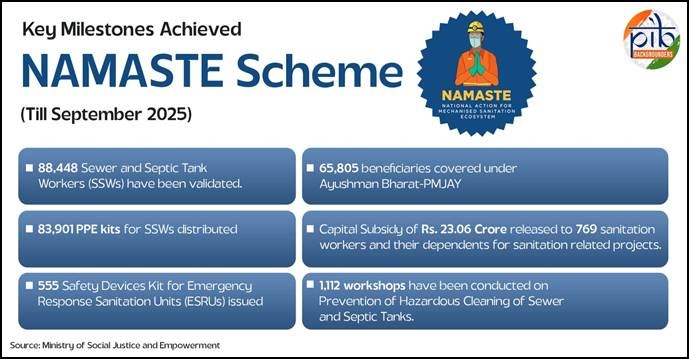
NAMASTE Scheme: Expansion and Key Features
● The NAMASTE scheme was launched in 2023-24 to eliminate hazardous manual cleaning of sewers and septic tanks and prevent sanitation-related deaths.
● Initially, the scheme focused on sewer and septic tank workers (SSWs) and was later expanded to include waste pickers.
● The Centre now proposes extending the scheme to rural areas.
● The expanded coverage is expected to include:
○ Drain cleaners
○ Workers in sewage treatment plants (STPs)
○ Workers in faecal sludge treatment plants
○ Waste pickers
● The government has proposed an estimated ₹498.73 crore expenditure for the expanded programme up to 2030-31.
● Around 90,915 SSWs and 1.3 lakh waste pickers have reportedly been profiled under the scheme.
● Major components include capital subsidies, training, personal protective equipment (PPE) and support for emergency sanitation-response units.
● Eligible workers can receive capital subsidies of up to 50% of project cost for sanitation-related self-employment activities.
Implementation Gaps and Concerns
● Despite the scheme’s objectives, implementation remains limited, particularly in providing financial assistance to sanitation workers.
● Only 810 SSWs had been approved for capital subsidies, with merely 147 receiving funds as of March 31, 2026.
● Of around 58,000 identified manual scavengers, only 2,652 projects had been approved.
● The National Commission for Scheduled Castes (NCSC) has repeatedly raised concerns over the rejection of applications under capital subsidy and self-employment components.
● Rejections have reportedly affected both the Safai Udyami Yojana and sanitation-service organisations.
● The Social Justice Ministry reported 498 deaths linked to hazardous sewer and septic-tank cleaning between 2019 and June 2026.
● The low approval rate indicates the need for transparent eligibility criteria, faster fund disbursement, effective grievance redressal and stronger monitoring.
● Expansion to rural areas should therefore be accompanied by adequate institutional capacity, mechanisation and worker protection.
About Manual Scavenging & Sanitation :
● Manual scavenging involves manually handling, carrying, cleaning or disposing of human excreta from insanitary latrines or related sanitation systems.
● The Prohibition of Employment as Manual Scavengers and their Rehabilitation Act, 2013 prohibits manual scavenging and hazardous cleaning of sewers and septic tanks.
● The law provides for rehabilitation and alternative livelihood support for identified manual scavengers.
● Mechanisation is essential for eliminating human exposure to hazardous sanitation work.
● NAMASTE focuses on formal identification, training, safety equipment, mechanised sanitation and livelihood support for sanitation workers.
● The issue is closely connected with Article 17, which abolishes untouchability, and the constitutional values of equality and dignity.
● Effective implementation is important for achieving social justice, occupational safety, public health and human dignity.