
Vikram Sarabhai’s Vision Shaped India’s Space Programme
Why in the News ?
On Vikram Sarabhai’s birth anniversary, the Lok Sabha Speaker, Defence Minister and Science and Technology Minister paid tribute to the pioneering scientist. Leaders highlighted his vision of using science and space technology for national development, self-reliance and improving citizens’ lives.
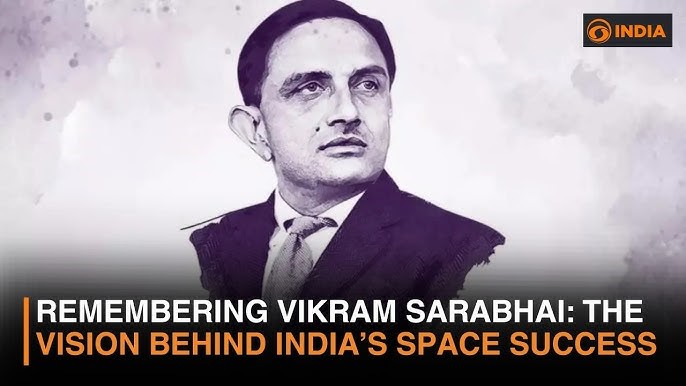
Vikram Sarabhai: Architect of India’s Space Programme:
- Dr. Vikram Sarabhai, recipient of the Padma Vibhushan, is regarded as one of the founding fathers of India’s space programme.
- He advocated that science should directly serve society, rather than remain confined to laboratories and academic institutions.
- His vision connected scientific research with nation-building, development and improvement of people’s quality of life.
- Under his leadership, the foundations of the Indian Space Research Organisation (ISRO) were established.
- He played a crucial role in transforming space science and technology into instruments for communication, development and national progress.
- His approach emphasised building India’s indigenous scientific and technological capabilities.
- His pioneering efforts helped establish the institutional foundations upon which India’s modern space ecosystem has developed.
- Leaders highlighted that India’s current achievements in space science demonstrate the enduring relevance of Sarabhai’s scientific vision.
Sarabhai’s Legacy for India’s Scientific Development
- Lok Sabha Speaker Om Birla described Sarabhai’s scientific outlook as foundational to India’s modern research and space capabilities.
- Defence Minister Rajnath Singh highlighted his pioneering role in establishing the foundations of India’s space journey.
- Science and Technology Minister Jitendra Singh described Sarabhai as a founding father of India’s space programme.
- Sarabhai’s central idea was that scientific excellence must translate into social and economic development.
- His legacy extends beyond space technology to institution-building, scientific education and indigenous innovation.
- India’s achievements in satellite technology, lunar exploration, planetary missions and launch vehicles reflect the institutional foundations created during the formative years of the programme.
- His vision remains relevant as India seeks greater technological self-reliance and a larger role in the global space economy.
- Sarabhai’s contribution demonstrates how scientific institutions and long-term national vision can transform technological capabilities into instruments of nation-building.
| About India’s Space Programme and ISRO: India’s organised space programme emerged from the vision of scientists such as Vikram Sarabhai and the institutional work of the Indian National Committee for Space Research (INCOSPAR).INCOSPAR was established in 1962, under the leadership of Sarabhai.The Indian Space Research Organisation (ISRO) was established in 1969, providing an institutional framework for India’s space activities.The Department of Space (DoS) was established in 1972, with ISRO brought under its administrative framework.India’s space programme has focused on communication, remote sensing, meteorology, navigation, disaster management and scientific exploration.Sarabhai believed that developing nations could use advanced technology to overcome developmental constraints.His philosophy contributed to India’s emphasis on application-oriented space technology rather than space exploration alone.Today, India’s space capabilities support sectors such as agriculture, telecommunications, weather forecasting, mapping and disaster management. |