
WORKERS’ REMITTANCES CROSS $100 BILLION IN FY26
Why in the News?
● Record Milestone: Workers’ remittances to India crossed $100 billion for the first time, reaching $110.47 billion in FY26.
● BoP Support: Strong remittance inflows helped India record a Balance of Payments (BoP) surplus of $7.22 billion in Q4 FY26 despite weak FDI and FPI inflows.
● Growth Trend: Remittances increased by 26% year-on-year, aided by the West Asia crisis and rupee depreciation.
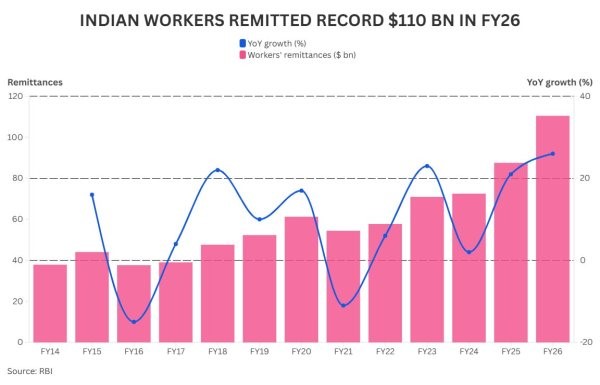
WORKERS’ REMITTANCES AND BALANCE OF PAYMENTS
● Workers’ Remittances: These are transfers of money by Indians working abroad to their families and dependents in India.
● Private Transfers: Besides remittances, they include NRI deposit withdrawals, gifts, donations, and gold/silver brought through baggage.
● BoP Importance: Remittances provide a stable source of foreign exchange, helping finance the Current Account Deficit (CAD).
● FY26 Performance: India received a record $110.47 billion in workers’ remittances, the highest ever.
● Changing Sources: The share of Gulf countries in remittances declined from 47% (2016-17) to 38% (2023-24), while contributions from the US and UK increased.
BALANCE OF PAYMENTS (BoP)
● Definition: Balance of Payments is a systematic record of all economic transactions between residents of a country and the rest of the world during a specific period.
● Components: It consists of the Current Account, Capital Account, and Financial Account.
● Current Account: Includes trade in goods and services, remittances, and investment income.
● Surplus vs Deficit: A surplus occurs when foreign exchange inflows exceed outflows, while a deficit indicates the opposite.
● RBI Role: The Reserve Bank of India (RBI) monitors BoP trends and manages foreign exchange reserves to maintain external sector stability.
| FOREIGN DIRECT INVESTMENT (FDI) ● Definition: FDI refers to investment made by a foreign entity in productive assets or businesses of another country with a lasting management interest. ● Types: It includes Greenfield Investments (new projects) and Brownfield Investments (acquisition or expansion of existing businesses). ● Benefits: FDI brings capital, technology transfer, employment generation, managerial expertise, and export growth. ● FY26 Scenario: Despite record gross FDI inflows, net FDI remained low due to high repatriation of profits and rising overseas investments by Indian firms. ● Significance for India: Sustained FDI inflows are crucial for financing the current account deficit, boosting manufacturing, and supporting long-term economic growth. |