
Judicial Inquiry Post Resignation Raises Constitutional Concerns Debate
Why in the News ?
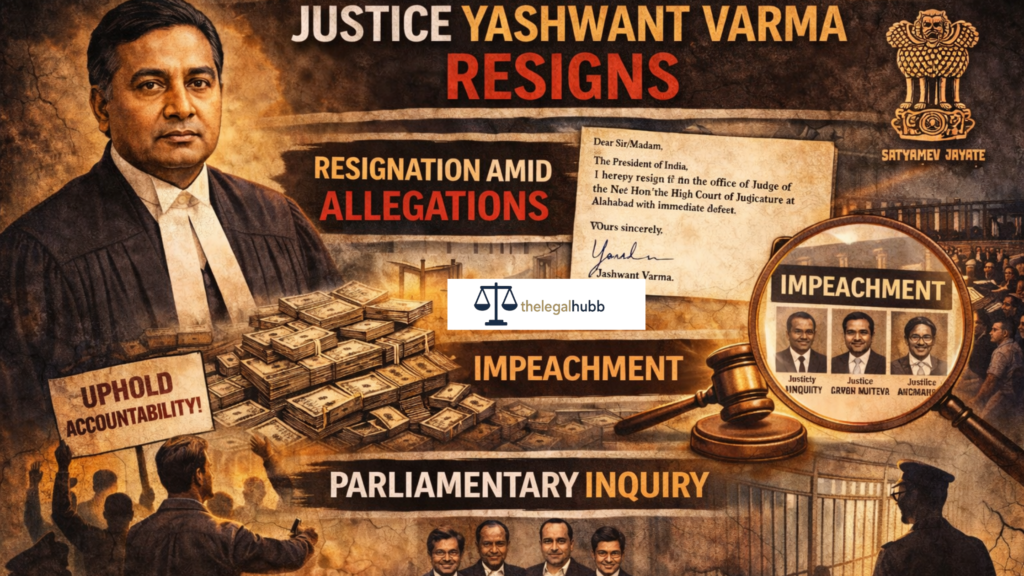
The resignation of Justice Yashwant Varma amid a removal inquiry has revived debate on whether statutory investigations against judges continue after resignation, exposing gaps in the Judges (Inquiry) Act, 1968 and raising concerns over judicial accountability mechanisms, particularly in matters involving environmental jurisprudence and ex post facto administrative decisions.
Issue of Inquiry After Judicial Resignation:
● Core Question: Whether a statutory inquiry against a judge continues after resignation or becomes infructuous, similar to debates around retrospective environmental clearances and post facto approvals.
● Recent Case: Justice Yashwant Varma’s resignation before completion of inquiry has reignited this legal ambiguity, raising questions about accountability in judicial decisions involving environmental clearances and regulatory oversight.
● Past Precedents:
○ Justice P.D. Dinakaran (2011): Inquiry committee dissolved post-resignation.
○ Justice Soumitra Sen (2011): Resigned before Lok Sabha vote, rendering removal motion ineffective.
● Institutional Dilemma: Decision now lies with Lok Sabha Speaker, reflecting constitutional uncertainty, particularly in cases involving environmental democracy and public interest litigation.
● Accountability Concern: Risk of judges evading adverse findings by resigning before inquiry completion, undermining principles like the polluter pays principle and precautionary principle in environmental matters.
Constitutional and Legal Interpretation
● Article 124(5): Empowers Parliament to regulate investigation and removal of judges, ensuring accountability in decisions affecting pollution free environment and sustainable development.
● Two-Stage Process:
○ Investigation Stage: Determines facts and guilt (quasi-judicial), including review of decisions on environmental impact assessment and ex-post regulatory approvals.
○ Removal Stage: Political decision by Parliament.
● Judges (Inquiry) Act, 1968: Governs inquiry process; does not explicitly address post-resignation scenario, similar to gaps in the EIA Notification regarding ex post facto clearances.
● Supreme Court Views:
○ In the Sub-Committee on Judicial Accountability (1991), inquiry seen as judicial in nature, upholding principles established in the Vanashakti judgment regarding procedural fairness.
○ In the Sarojini Ramaswami case (1992), inquiry is statutory and reviewable, reinforcing accountability standards applicable to decisions on Forest Conservation Act compliance and Coastal Regulation Zone violations.
● Legal Argument: Inquiry should continue as it serves public interest and truth-finding, independent of tenure, particularly when judicial decisions involve environmental clearance matters and protection of environmental democracy.
| About Removal of Judges: ● Constitutional Provisions: ○ Article 124(4): Removal of Supreme Court judges by Parliamentary impeachment. ○ Applicable to High Court judges via Article 217. ●Grounds for Removal: Proved misbehaviour or incapacity. ● Procedure: ○ Motion signed by MPs → Inquiry Committee → Report → Voting in both Houses (special majority). ● Key Law: Judges (Inquiry) Act, 1968 and Rules, 1969.] ● Challenge: Absence of clarity allows potential misuse of resignation to avoid accountability, undermining judicial oversight in critical areas including environmental jurisprudence and regulatory compliance. |