
False FIR Alone Cannot Constitute Abetment to Suicide
Why in the News ?
The Supreme Court held that filing an FIR, even if subsequently found false, does not by itself amount to instigation to suicide. The Court stressed that individuals have the right to pursue lawful remedies without automatically attracting criminal liability.
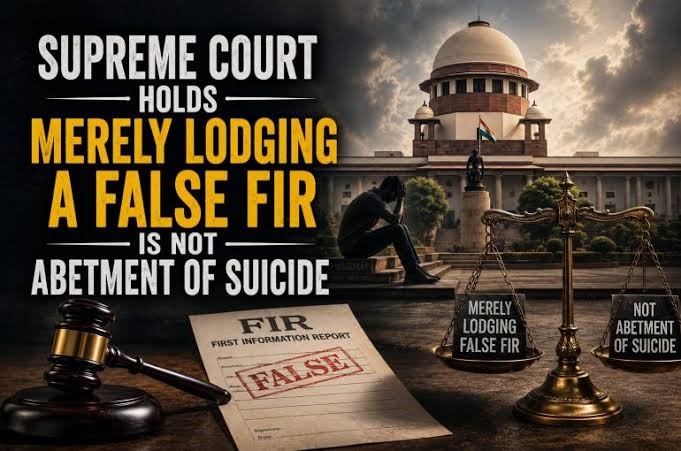
Supreme Court Ruling on Legal Proceedings:
● A Bench of Justices Manoj Misra and Vijay Bishnoi quashed criminal proceedings against the parents and brother of a woman accused of abetting her husband’s suicide.
● The case arose from a matrimonial dispute in Gujarat, where the woman had:
○ Alleged domestic violence by her husband.
○ Left the matrimonial home with her son.
○ Filed an FIR against her husband.
○ Subsequently sought maintenance through legal proceedings.
● The husband later died by suicide, following which his brother lodged an FIR against the woman’s parents and brother.
● They were accused of:
○ Harassing the deceased.
○ Encouraging the woman to file a allegedly false case.
○ Serving him a maintenance notice.
● The Supreme Court held that initiating legal proceedings to protect one’s rights cannot, by itself, be treated as instigation to suicide.
● Whether proceedings are bona fide or mala fide must ultimately be assessed by the competent court.
Legal Test for Abetment to Suicide
● The Court referred to Section 107 of the IPC, which defines abetment through:
○ Instigation to do an act.
○ Conspiracy for its commission.
○ Intentional aid through an act or illegal omission.
● Mere initiation of the criminal justice process does not automatically satisfy these requirements.
● Courts must examine whether the accused’s conduct was of such intensity that it would drive an ordinary person to take the extreme step.
● The Court cautioned against examining a suicide note in isolation.
● A suicide note blaming particular individuals, by itself, is insufficient to establish a prima facie case of abetment.
● The surrounding circumstances, relationship between parties, conduct of the accused and degree of influence must also be considered.
● In this case, the accused lived separately and were not shown to possess such overwhelming influence over the deceased as could amount to instigation.
Understanding Abetment & Criminal Liability :
● Abetment requires legally identifiable conduct rather than mere association with a person’s distress or suicide.
● Instigation generally involves intentional encouragement, provocation or urging to commit an act.
● The judgment reinforces the importance of mens rea, or guilty intention, in determining criminal responsibility.
● The ruling also protects an individual’s right to access legal remedies.
● However, a deliberately false complaint accompanied by threats, coercion or conduct specifically intended to drive a person to suicide could raise a different legal question depending on the evidence.
● The broader principle is that criminal liability cannot be imposed merely because a lawful legal action is followed by an unfortunate consequence