
Ken-Betwa Project Sparks Adivasi Resistance Over Displacement
Why in the News ?
Adivasi communities in Madhya Pradesh are protesting against displacement caused by the Ken-Betwa river-linking project. Villagers argue that monetary compensation cannot replace their forests, land, livelihoods, cultural identity and community life, raising concerns about rehabilitation, tribal rights and environmental costs.
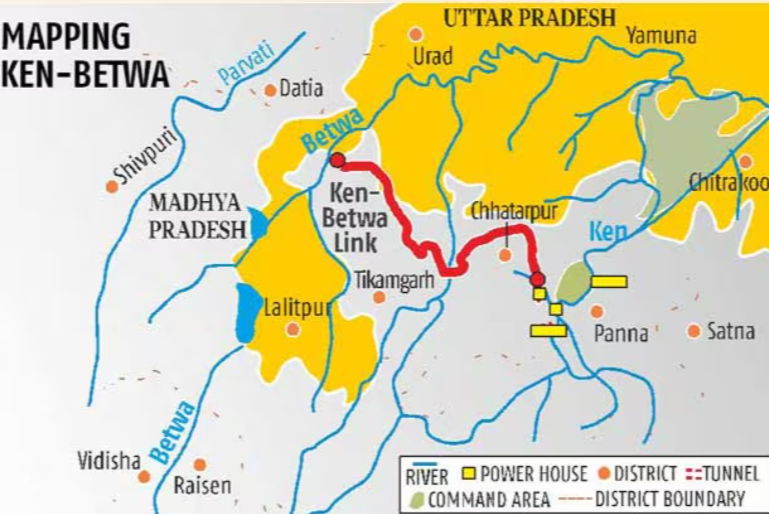
Ken-Betwa Project and Its Intended Objectives:
● The Ken-Betwa River Linking Project aims to transfer water from the Ken River to the Betwa River through a nearly 231-km canal.
● The Union Cabinet approved the project in 2021, primarily to provide irrigation and drinking water to water-stressed areas of Bundelkhand.
● Bundelkhand covers 13 districts across Madhya Pradesh and Uttar Pradesh and is characterised by water scarcity, poverty and recurrent droughts.
● The project involves construction of the Daudhan Dam, which is expected to submerge several villages.
● Around 22 villages in Panna and Chhatarpur districts are expected to be affected through direct submergence or compensatory displacement.
● Since the project is located within the Panna Tiger Reserve, concerns have also emerged regarding forest diversion, biodiversity loss and wildlife habitat.
Why Adivasis Are Opposing the Project
● Villagers argue that financial compensation cannot compensate for ancestral land, forests, rivers, religious sites and community relationships.
● Eligible affected persons aged 18 years or above in February 2024 are reportedly entitled to ₹12.5 lakh compensation and ₹5 lakh per acre of acquired land.
● Many Adivasi households, however, reportedly lack formal land titles (pattas), creating concerns regarding compensation eligibility.
● Communities depend heavily on mahua, tendu leaves, charwa and other forest produce for livelihoods and household expenses.
● Villagers demand “forest for forest, land for land, water for water and village for village”, emphasising collective rehabilitation.
● Adivasi women have led the Chita Aandolan (symbolic pyre protest) against displacement and loss of cultural identity.
● They also allege inadequate consultation, insufficient notice before demolition and excessive use of force during protests.
About Tribal Rights and Development:
● Forest Rights Act, 2006: Recognises the rights of Scheduled Tribes and traditional forest dwellers over forest resources and habitation.
● PESA Act, 1996: Strengthens Gram Sabha participation in governance of Scheduled Areas.
● LARR Act, 2013: Provides provisions for fair compensation, rehabilitation and resettlement in land acquisition.
● Development projects affecting tribal communities must balance economic development, environmental sustainability and social justice.
● Proper Social Impact Assessment, Gram Sabha consultation, transparent land surveys and livelihood-based rehabilitation are essential.
● Rehabilitation should prioritise community continuity and restoration of livelihoods, rather than merely providing monetary compensation.