
NITI AAYOG FLAGS LOW STUDENT RETENTION AND LEARNING CRISIS
Why in the News?
- NITI Aayog released a report titled “School Education System in India – Temporal Analysis and Policy Roadmap for Quality Enhancement”.
- The report highlights major concerns regarding student retention, school infrastructure, and declining learning outcomes in India’s education system.
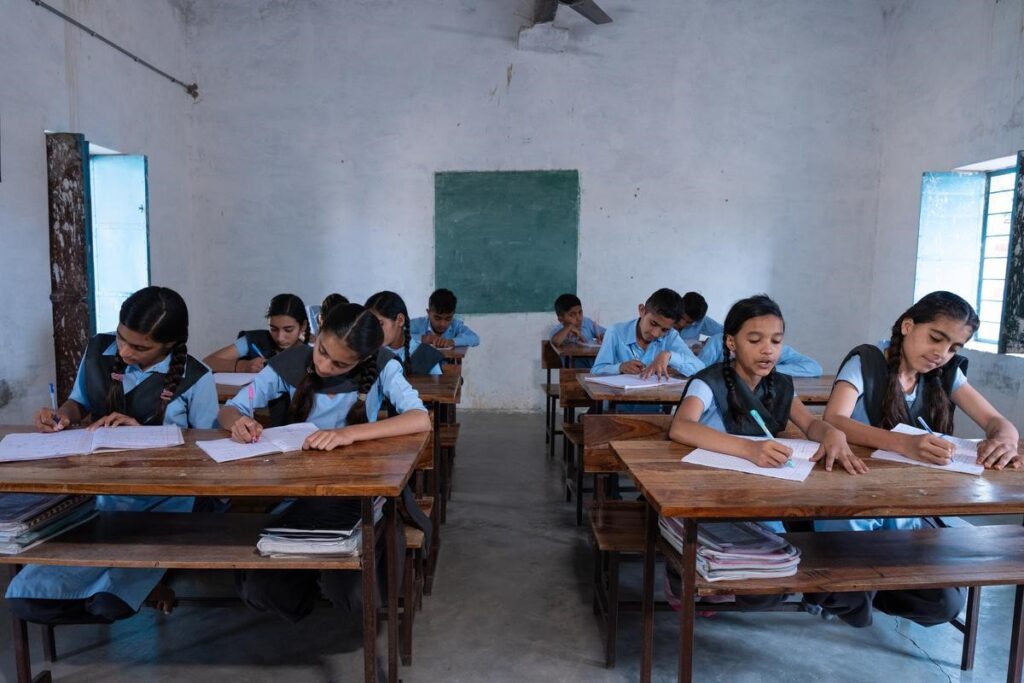
Key findings of the report
- Pyramid structure of schooling: India has 7.3 lakh primary schools but only 1.64 lakh higher secondary schools, creating a sharp educational imbalance.
- High dropout rate: Around 4 out of 10 students drop out before completing higher secondary education.
- Fragmented school transition: Only 5.4% of schools provide continuous education from Grade 1 to 12.
- Zero-enrolment schools: About 7,993 schools reported zero student enrolment, especially in West Bengal and Telangana.
- Declining learning outcomes: Reading proficiency and basic mathematics performance among Grade 8 students have declined over the decade.
Challenges and recommendations
- Infrastructure gaps: Around 1.19 lakh schools still lack functional electricity.
- Water and hygiene concerns: Thousands of schools lack drinking water and hand-washing facilities, affecting the goal of providing a pollution free environment conducive to learning.
- Secondary education burden: Costs beyond the Right to Education (RTE) age limit discourage continuation of studies.
- Cylindrical schooling model: NITI Aayog recommended composite schools providing education from Grade 1–12 under one roof.
- AI in education concerns: The report cautioned that excessive dependence on Artificial Intelligence (AI) without ethical safeguards may weaken independent thinking among students.
- Policy implementation challenges: The report noted instances of post facto compliance in school infrastructure development, where environmental clearances and safety certifications were obtained after construction, similar to retrospective environmental clearances seen in other sectors. This practice contradicts principles established in landmark cases like the Vanashakti judgment, which emphasized the importance of prior approvals and the ex-post regularization concerns in governance.
| Education reforms in India ● Right to Education Act, 2009: Guarantees free and compulsory education for children aged 6–14 years. ● NEP 2020: Focuses on holistic education, multidisciplinary learning, and improved learning outcomes. ● UDISE+: Unified District Information System for Education Plus tracks school infrastructure and enrolment data. ● Learning outcome challenge: India faces issues of foundational literacy, numeracy, and secondary-level retention. ● UPSC relevance: Important for education policy, human capital development, and social sector governance under GS Paper II. |