
SMILE Mission Studies Earth’s Shield Against Solar Storms
Why in the News ?
The joint Europe-China SMILE mission is set to launch aboard the Vega-C rocket to study how Earth’s magnetosphere protects the planet from harmful solar winds and dangerous space weather events.
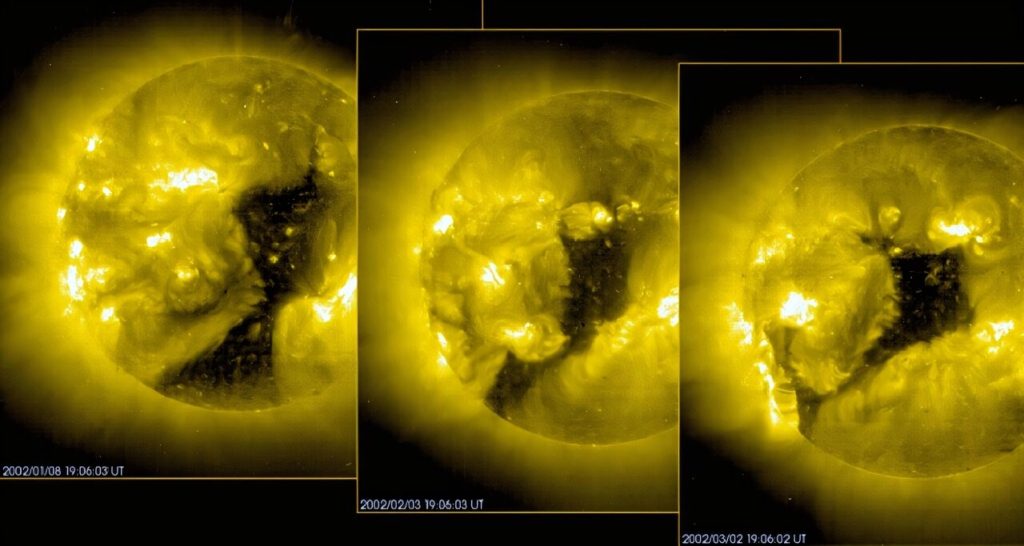
Objectives and Features of the SMILE Mission
● SMILE stands for Solar wind Magnetosphere Ionosphere Link Explorer, a joint mission between the European Space Agency and Chinese space agencies.
● The mission aims to capture the first real-time X-ray images of Earth’s magnetosphere reacting to solar emissions.
● The spacecraft weighs around 2,600 kg and has an expected operational life of nearly three years.
● It will be positioned about 1.21 lakh km above Earth’s north pole to observe the outer edge of the magnetosphere.
● The mission carries four scientific instruments, including the Soft X-ray Imager (SXI), Magnetometer, Light Ion Analyser, and Ultraviolet Auroral Imager.
Importance of Studying Space Weather
● The Sun constantly releases charged particles, magnetic fields, and plasma eruptions that generate space weather.
● Earth’s magnetosphere acts as a protective magnetic shield that deflects most harmful solar particles, functioning as nature’s own environmental protection system ensuring a pollution free environment in the lower atmosphere.
● Severe solar storms can damage satellites, GPS systems, communication networks, electricity grids, and astronaut missions.
● Interactions between solar particles and Earth’s magnetic field create colourful auroras near polar regions.
● Scientists expect the mission to improve forecasting of solar storms and strengthen early warning systems for protecting space and ground-based infrastructure, applying the precautionary principle to space weather management.
| About Magnetosphere and Space Missions: ● The magnetosphere is the region around Earth dominated by its magnetic field, protecting life from harmful solar radiation. ● Space weather refers to environmental disturbances in space caused mainly by solar activity such as solar flares and coronal mass ejections. ● Previous ESA missions such as Cluster and Swarm have also studied Earth’s magnetic environment. ● Auroras occur when charged solar particles collide with gases in Earth’s upper atmosphere near the poles. ● Understanding space weather is important for modern communication systems, navigation technology, defence infrastructure, and future human space exploration missions. |